The Fürth Hop-Pickers’ Fountain
A lost monument to the hop trade
The Fürth Hop-Pickers’ Fountain
A lost monument to the hop trade
By Christoph Pinzl
Over the course of the 19th century, hops became a booming crop in Germany. The centre of this enthusiasm for hops was Middle Franconia. Right at the heart of it all was the town of Fürth. However, the town’s true affinity for hops stemmed less from the numerous hop growers in the surrounding area. Unlike in many other Bavarian towns, Jews and Christians had lived side by side and together here without interruption since the Middle Ages. As more and more Jewish hop-merchant families moved from the Franconian rural communities to the nearby towns during the 19th century, Fürth therefore emerged as a particularly desirable destination for this up-and-coming merchant class. As early as 1859, 19 hop merchants were listed in the Fürth directory; 15 years later, the number had risen to 42, a large proportion of whom bore Jewish surnames. They contributed significantly to the town’s prosperity, and many actively supported culture and the local community.
In this respect, it was not entirely far-fetched when, in 1907, the Fürth Beautification Society came up with the idea of erecting a monument in honour of the Fürth hop trade. A monument in the form of a fountain. The location chosen was a square-like extension of Königswarterstraße, on the corner of Gabelsbergerstraße. This was not far from Fürth’s main railway station and just as close to the station of the old Ludwig Railway, on which the famous ‘Adler’ locomotive had transported its beer barrels back in 1835. A good location, for without a railway connection, a successful hop trade could never have developed in the first place. Moreover, it was in the part of Fürth where many hop-merchant families had once had their homes. Fittingly, the aforementioned Ludwig Railway also ran right past the fountain on its way to neighbouring Nuremberg – which, when it comes to the hop trade, is certainly not the least important town. Nevertheless, some residents of Fürth were displeased with the rather isolated location in the middle of the road, lacking a lawn or surrounding greenery.
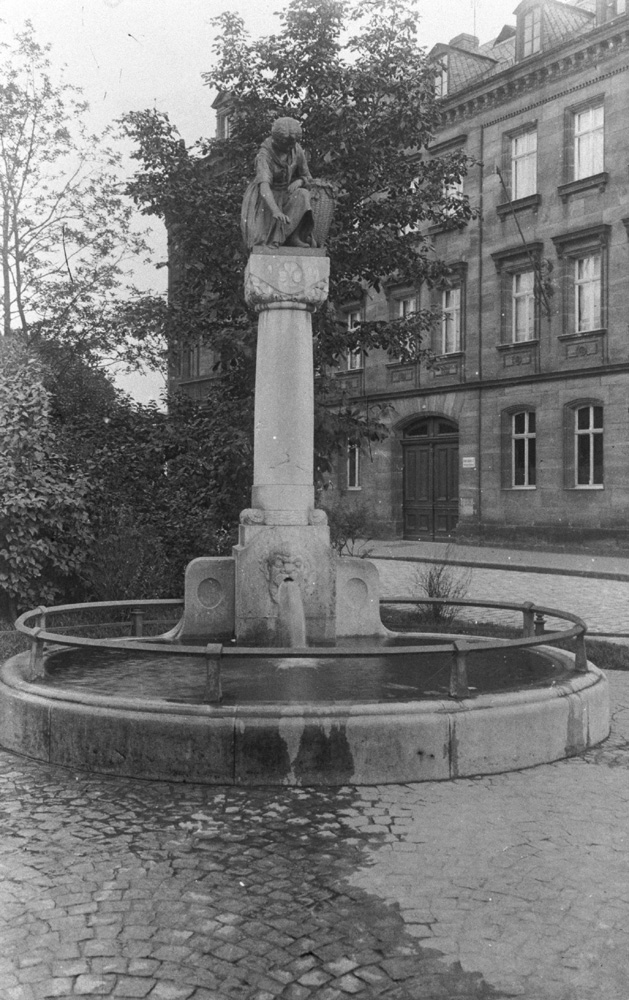
The Fürth Hop-Pickers’ Fountain, around 1920.
Even though Fürth’s connection to hops lay in trade rather than cultivation, a hop-picker was chosen as the motif for the fountain. She seemed to represent hops in a more striking and charming way than a drab merchant figure in a suit and top hat. This is somewhat understandable, even though it is unlikely that a hop-picker ever actually picked hop cones into a basket in Fürth. The plinth on which the figure stood was adorned with reliefs of hop cones and hop leaves carved from Jura limestone. The hop-picker herself was cast in bronze.
The Munich sculptor Josef Köpf was commissioned to create the figure. Unlike today, with its deeply ingrained animosity towards Old Bavarians, people in Franconia at that time had no qualms about awarding such a commission to the rival metropolis in Upper Bavaria. Köpf may have been a renowned artist, but he clearly had no idea about hop-growing. No one has ever harvested hop cones in the hunched, kneeling posture in which he sculpted his metal hop-picker. But somehow it did fit in rather well with Fürth and its hop merchants, where, after all, no one had ever got their fingers dirty plucking hops. A memo on the design diplomatically noted that it was supposedly “the kneeling figure of a hop-picker taking a rest by the wayside”. Well, then.
Total cost of the fountain, including construction work: 5,707 marks, covered in full by the Fürth Beautification Society. The town received the fountain monument as a gift on the condition that it would keep it in good repair – in other words, take over its operation and maintenance. The fountain was unveiled on 27 September 1907, at half past eleven on a Friday morning.
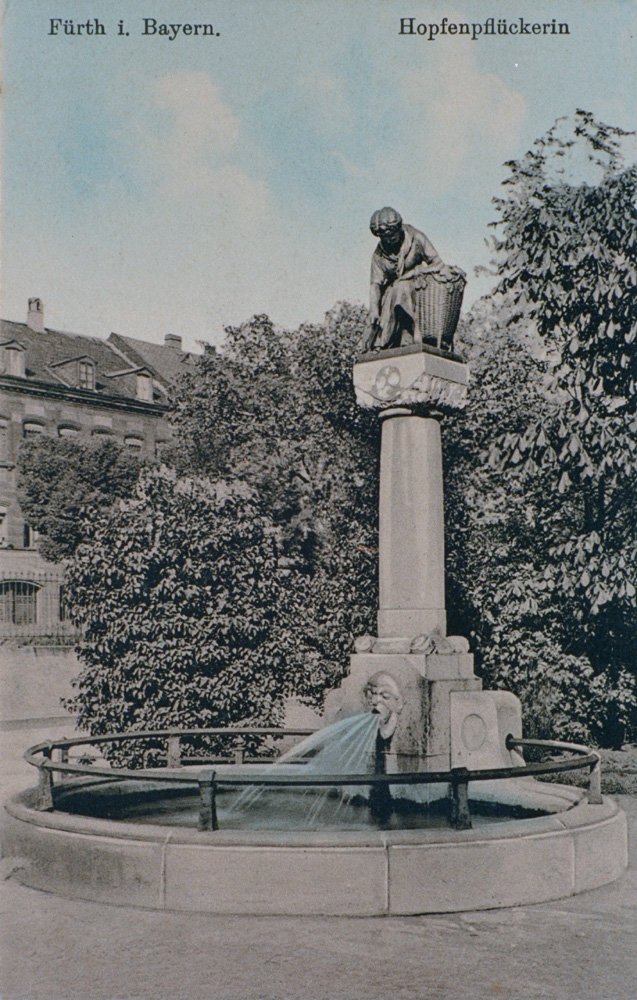
A postcard image of the fountain, coloured in retrospect and reproduced mirror-inverted.
Reading through the old reports, one cannot help but get the impression that, in the years that followed, the people of Fürth never quite warmed to their fountain monument. A light-hearted article in the local newspaper from September 1932 recounted the story of a tipsy passer-by who wanted to “have a nocturnal conversation” with the bronze fiddler. “And when she failed to understand him because of his slurred speech, he – who, after all, could never have put himself in such a blissful state without her work – called her all sorts of unflattering nicknames. Eventually, he came to believe that a brown barley brew was flowing from the fountain spout at her feet. After a thorough taste test, he is said to have turned away with a shudder.”
The hop monument was never meant to last all that long anyway. During the Second World War, the bronze figure was in danger of being scrapped – the raw material had become too vital to the war effort. After the war, the fountain stood in the area for a few more years, now without the hop-picker on top. In the autumn of 1954, it was finally demolished on the orders of the Fürth City Planning Office. Not least because, by that time, hardly anyone knew anything about the former importance of hops to Fürth. But perhaps also because people did not wish to be reminded of the many Jewish merchant families and their disappearance during the Nazi era, not even indirectly through such an old monument. Adolf-Hitler-Straße, as the fountain’s location had been called from 1933 onwards, was quickly renamed Königswarterstraße again after the war, and the compromising Third Reich street sign was hastily removed. It was not until 2022 that it resurfaced by chance during excavation work.
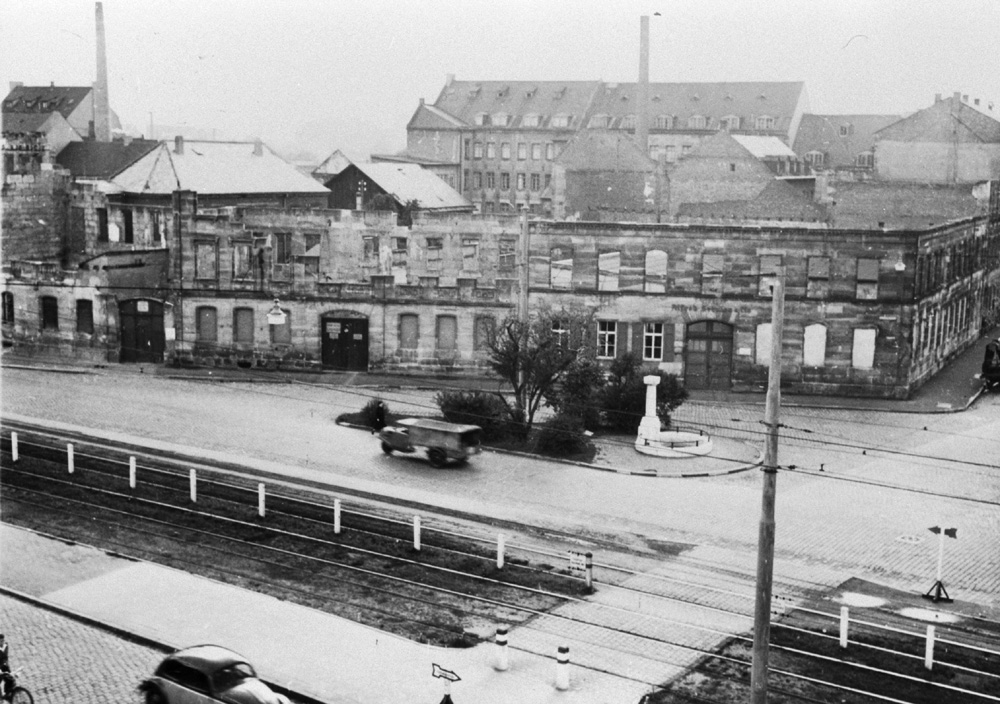
A bird’s-eye view of the fountain’s location, circa 1942. The bronze figure had already been removed.
All tentative efforts in the years that followed to re-erect the fountain failed. Too expensive, they said. Always a handy excuse when other ideas take root in the minds of town planners. In this case, a nearby high-rise building, which the fountain stood in the way of. Today, only those in the know are aware of the former connection between hops and the town. The former site is now home to Suppenkaspar and Anna’s Schaschlik Haus – with an accent, of course. Nothing in Fürth remains to remind us of the Hop-Pickers’ Fountain.
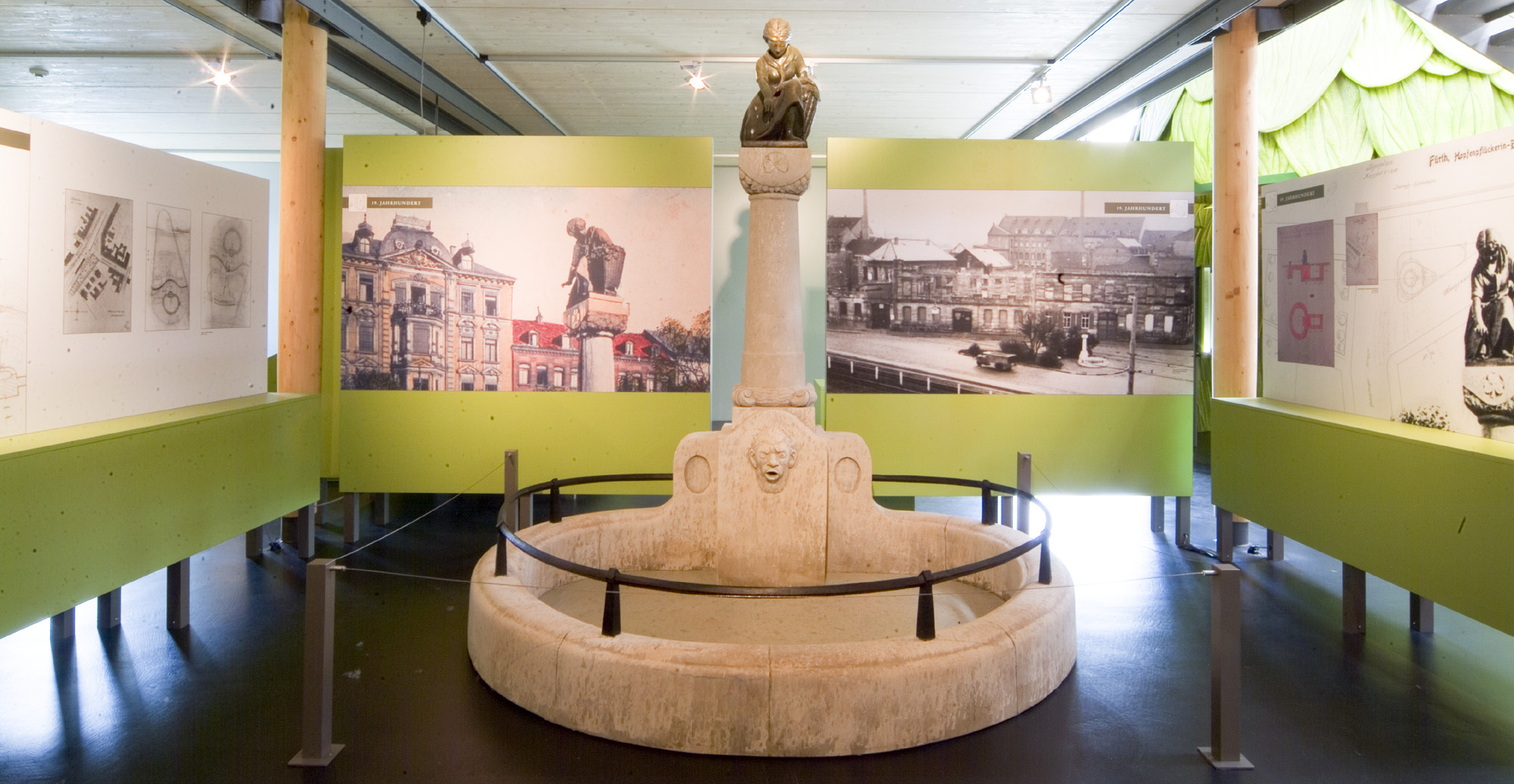
Not there, anyway. But here with us, at the German Hop Museum. Our fountain is the work of the Munich-based set designer and artist Sigwart Donat. As is so often the case, we came into contact with him through a roundabout route. Even though he was initially a little amused by our request, he was quickly won over by the idea of bringing the Fürth fountain back to life. We agreed not to disclose the fee he was to be paid; given the effort and perfection Donat put into his work, it was undoubtedly a pittance. His fountain model turned out so deceptively realistic that we initially had considerable trouble preventing our visitors from sitting comfortably on the edge of the fountain or on the railing. Both would immediately give way under the weight; after all, neither stone nor iron had been used here, but rather a lightweight, polystyrene-like material typically used in stage set construction. Even today, the majority of our visitors believe that the former Fürth Hop-Picker’s Fountain has moved to our museum. In a way, it has. At least in the form of a tangible reminder of the once-glorious era of hop-growing in Fürth.