The German Kiln
Museum items – for 21 years (4)
The German Kiln
Museum items – for 21 years (4)
By Christoph Pinzl
In the history of hop growing, there are many things whose exact origins remain more or less unknown. One such thing is the “German kiln.” In our museum, we have built a faithful replica of such a kiln.
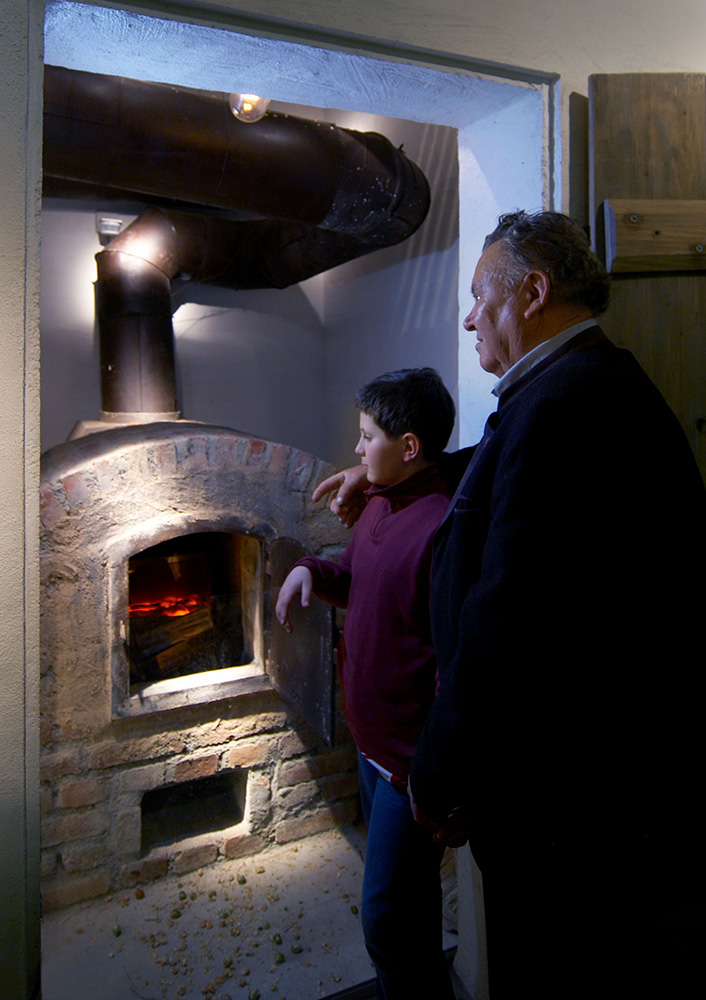
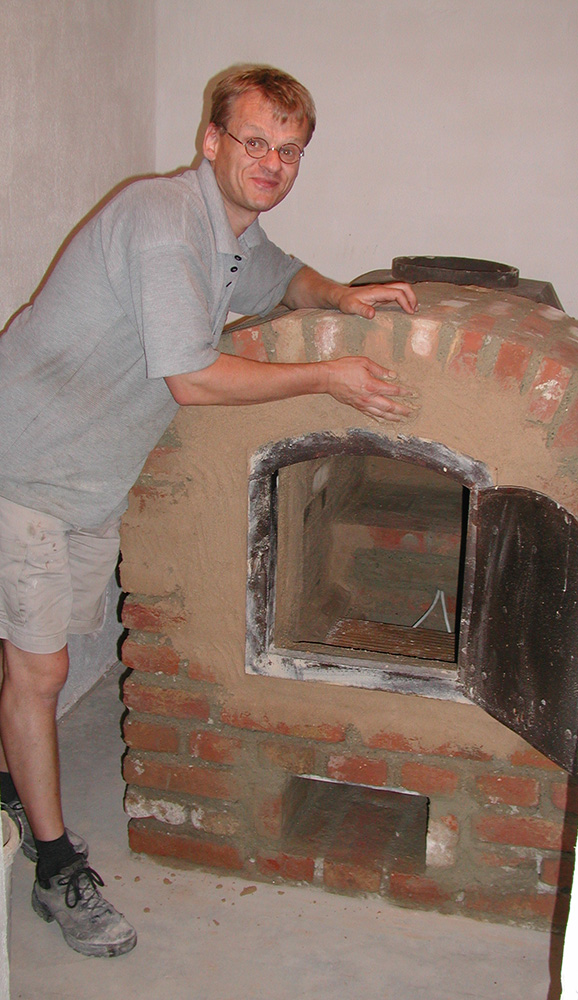
The oven of the German kiln in the museum with visitors, 2010.
For centuries, hops were simply dried in the open air after harvesting. Not necessarily in the blazing sun, as this was never good for the ingredients in the hop cones. It was better in the shade or, ideally, indoors, in the attic, in the barn, or in the hallway. As long as being a hop farmer meant planting a maximum of a few hundred poles in a fenced-in hop garden, this method of air drying worked quite well. When people started to get more involved in cultivation, they had drying racks built, simple wooden frames with a base made of cane, willow branches, or even wire, on which they spread out the cones to dry. Hung one above the other, these racks saved a lot of space. And there was no need to invest in a new drying house or similar facility right away. Who knew whether hop cultivation would really work in the long run?
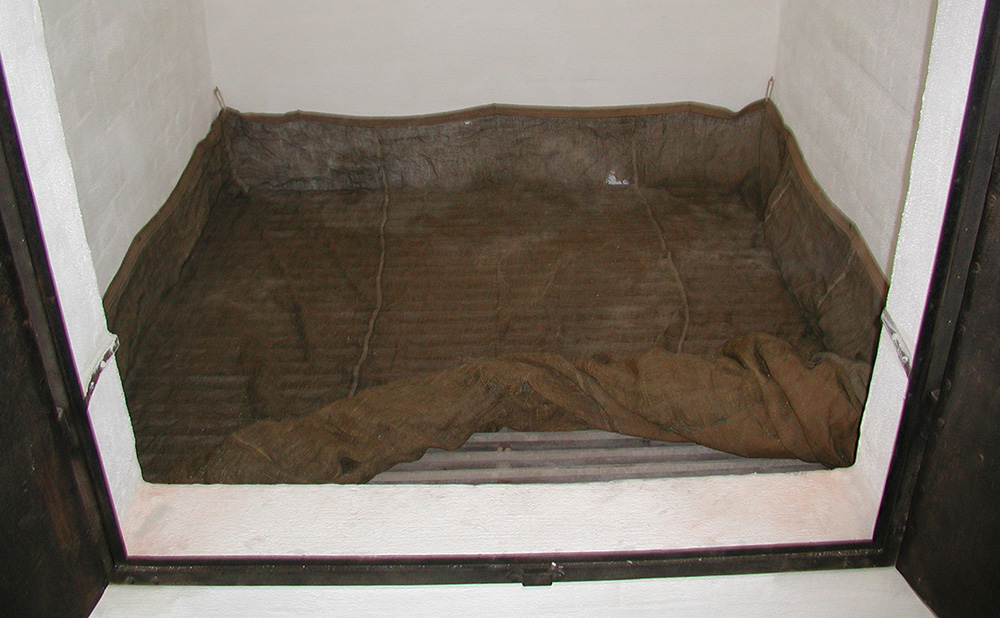
In regions where people devoted themselves fully to hops from the mid-19th century onwards, however, air drying was soon called into question. Whether on racks, in the attic, or elsewhere, “hot air drying” became the standard, meaning that instead of simply using the normal warm ambient air for drying, artificially heated air from an oven was used. The first ideas for this date back to the early 19th century. For whatever reason, literature tends to credit Frenchman Christophe J. Mathieu de Dombasle with being the first to develop a heatable hop kiln around 1830. In fact, however, such designs existed much earlier. As was so often the case at that time, the model was English hop cultivation. These kilns were basically divided into two parts: they consisted of a heating area with a stove at the bottom and a drying area on the floor above. The stove was heated, and the hop cones were placed above it to dry. Two details were essential here: 1. The smoke from the stove did not pass through the hop cones, but into the chimney. 2. The cones were not placed directly on an air-permeable grate or similar, but on a cloth that could be carried out of the drying room. In the Hallertau region, this cloth was called the “Plocha.” This was an important detail, as it prevented the cones from falling down onto the stove and burning.
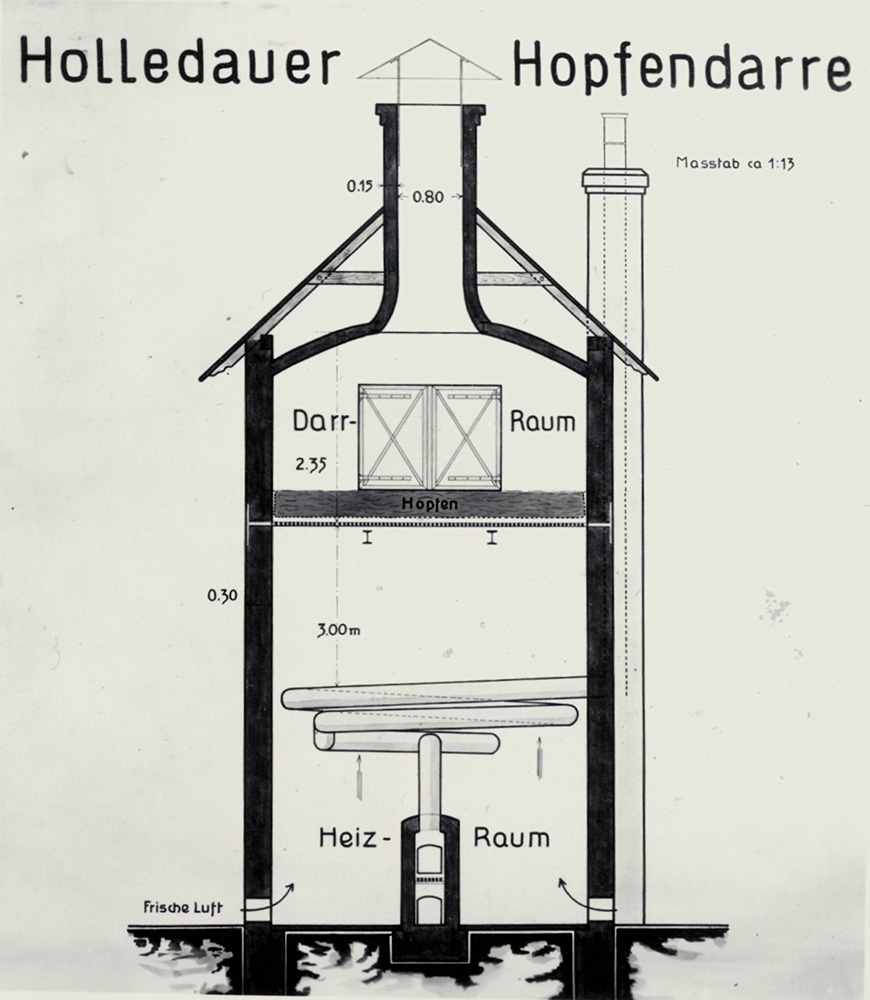
Diagram of a German/Hallertau kiln, 1931.
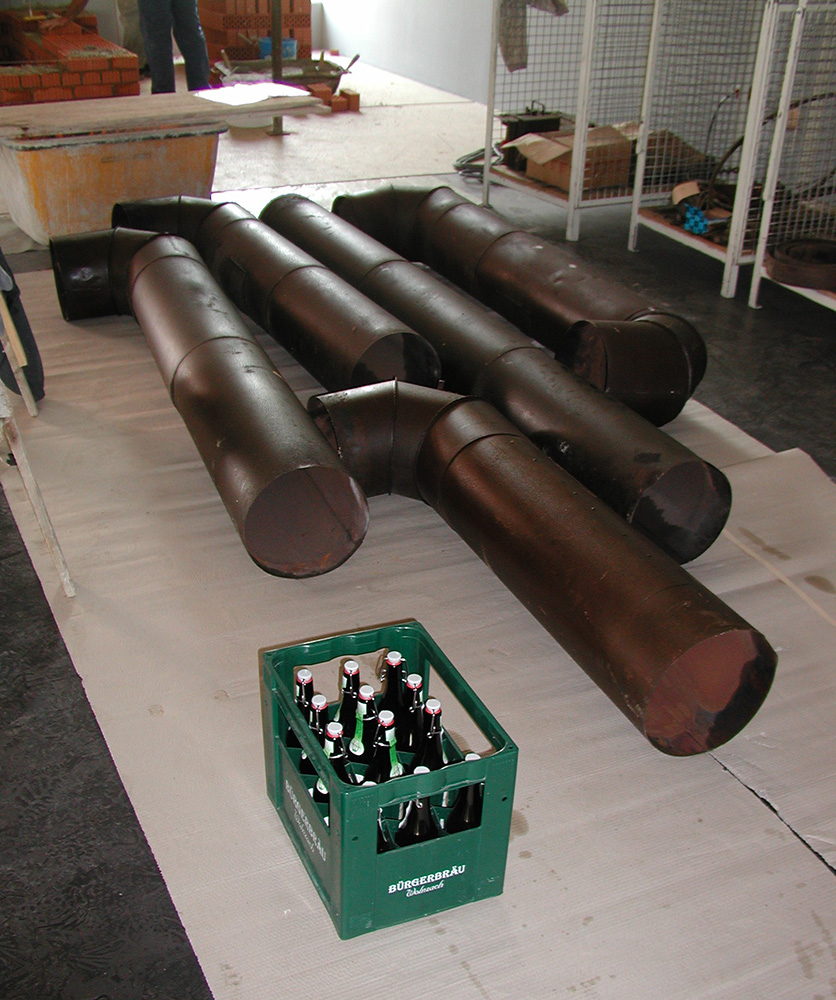
Whoever was the first to build such a hop kiln was almost certainly inspired by the design of English malt kilns, which had been built in the form described since the 18th century. A famous example was provided by the Spaten brewery in Munich, where such an English malt kiln had been in operation since 1810. This was one of the cornerstones of the later success of this brewery, which was to become one of the largest in the world during the 19th century. What made the English malt kilns particularly efficient was a circulating system of sheet metal pipes between the oven and the drying area. Like a snail made of thick oven pipes. This allowed the amount of warm air for drying to be increased considerably. Everything ran much faster and more evenly as a result. Today, we would call this a heat exchanger. It was a revolution in drying technology.
And now we finally come to the German kiln. A brick oven, smoke pipe spiral, and a „Plocha“ were its key components, just like the English kiln. However, such a construction required its own tower-like building, otherwise it would not function properly. The Hallertauers built these kiln towers from around 1890 onwards as extensions to their farmhouses. In large numbers. By 1900, there were already almost 1,000 of them in the Hallertau region. The Wolnzach master carpenter Max Eder seems to have played an important role in their spread. In literature, he is often referred to as the “inventor” of the German kiln. Which, of course, was not entirely true, as described above. Nevertheless, in 1905, Eder received an award from the Bavarian Wittelsbach State Foundation for his work on the new kilning technology.
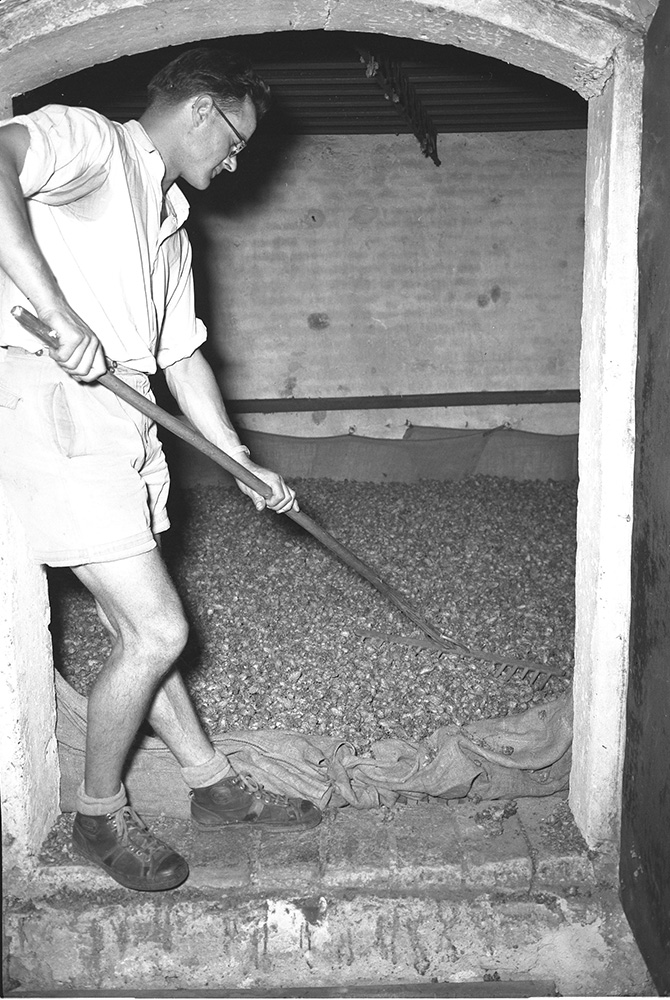
The piled hop cones are turned in the drying room of a German kiln. The cloth (the “Plocha”) on which the cones lie is clearly visible. Photo from 1958.
It is also somewhat unusual that all records consistently refer to the “Hallertauer kiln.” However, when asked, old hop farmers invariably speak of the “German kiln.” Whether there were any differences at all, and if so, what they were, can no longer be clarified today. It is possible that the term was coined somewhat later to distinguish the “German” from the “Bohemian kiln,” which emerged in the 1920s and with its basculting tiers was even more advanced than the German/Hallertauer kiln.
It also remains unclear how and why the Hallertau farmers managed to equip almost the entire growing area with such structures in such a short time. After all, they were not necessarily free of charge. It is also unclear why their Franconian colleagues in Spalt and, above all, in Hersbruck were not particularly keen on German kilns and preferred to stick with air drying or, at least, significantly smaller domestic kilns – and thus missed the boat when it came to the future of hop growing. As early as 1912, the Hallertau region was able to boast the title of “largest hop-growing region in Germany.” The spread of the German kiln contributed significantly to this title.

Sketch of the construction of a German kiln in Ampertshausen (Hallertau), 1914
But technical development did not stand still. By the end of World War II at the latest, and with the advent of the hop-picking machine in the mid-1950s, the “old German kiln” was causing considerable problems. It was now far too inefficient for the new requirements. In addition, after decades of use, its old smoke pipes had become weak, thin, and rusty, and at the right moment, flames burst out of them. Many hop farmers could not afford a new kiln with oil firing and basculting tiers on top of the new, extremely expensive picking machine. And so they preferred to fire up their old German kilns all night long until the pipes glowed, even if it cost them their sleep. This had fatal consequences: in some places, the volunteer fire departments were kept busy throughout the harvest because one German kiln after another went up in flames.
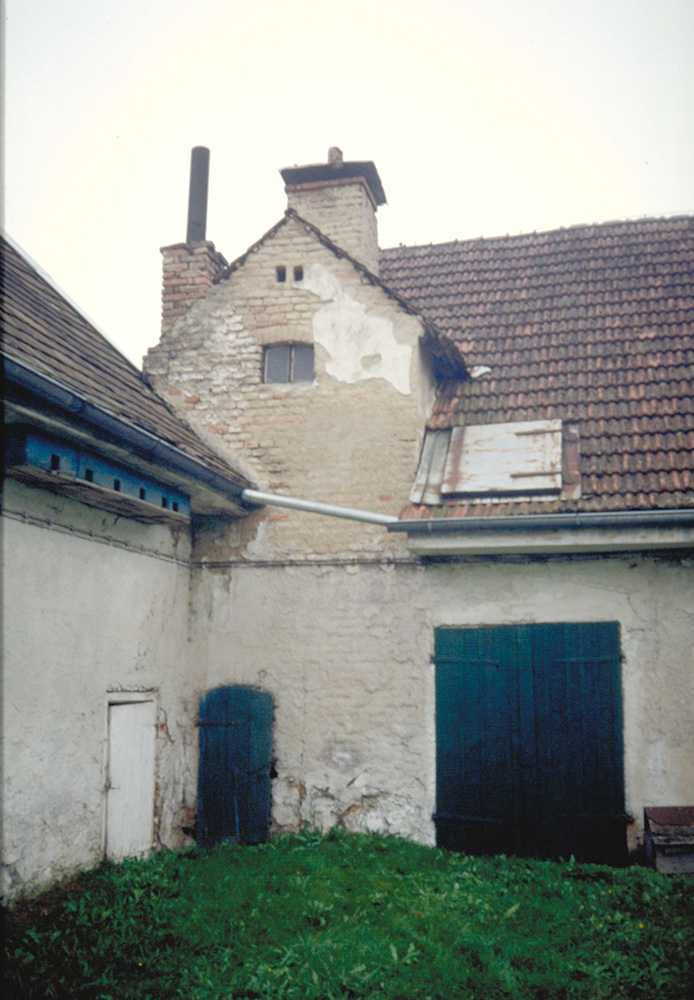
Former German kiln in Waal (Hallertau), 1994.
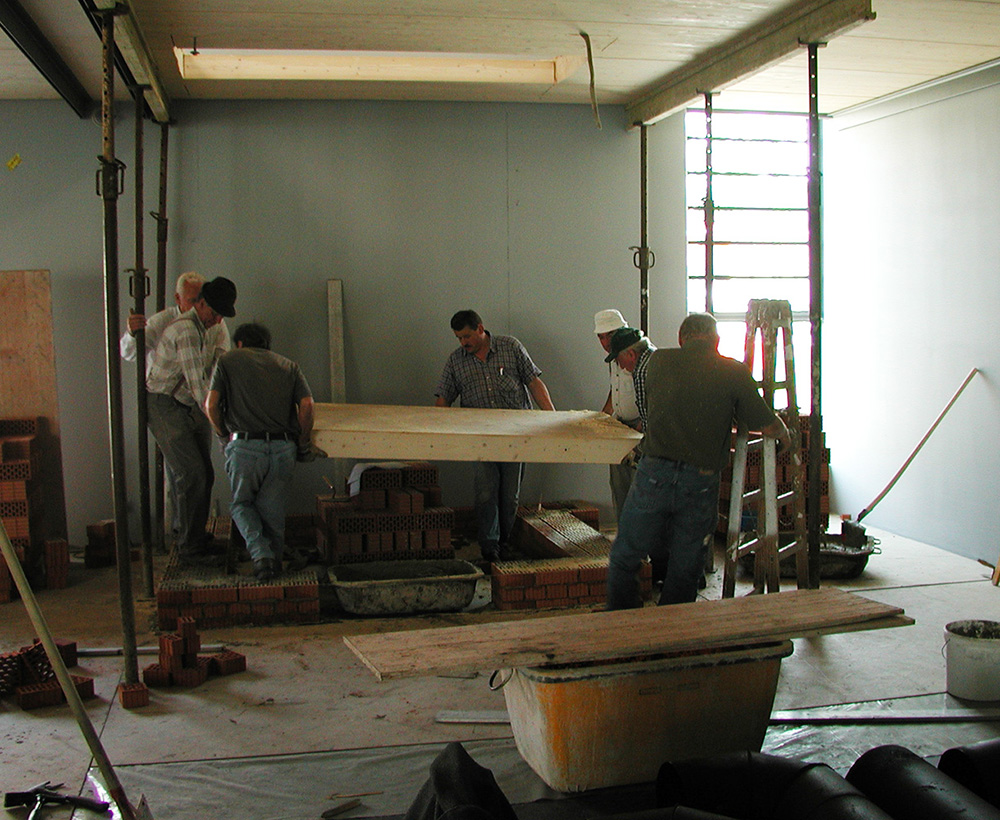
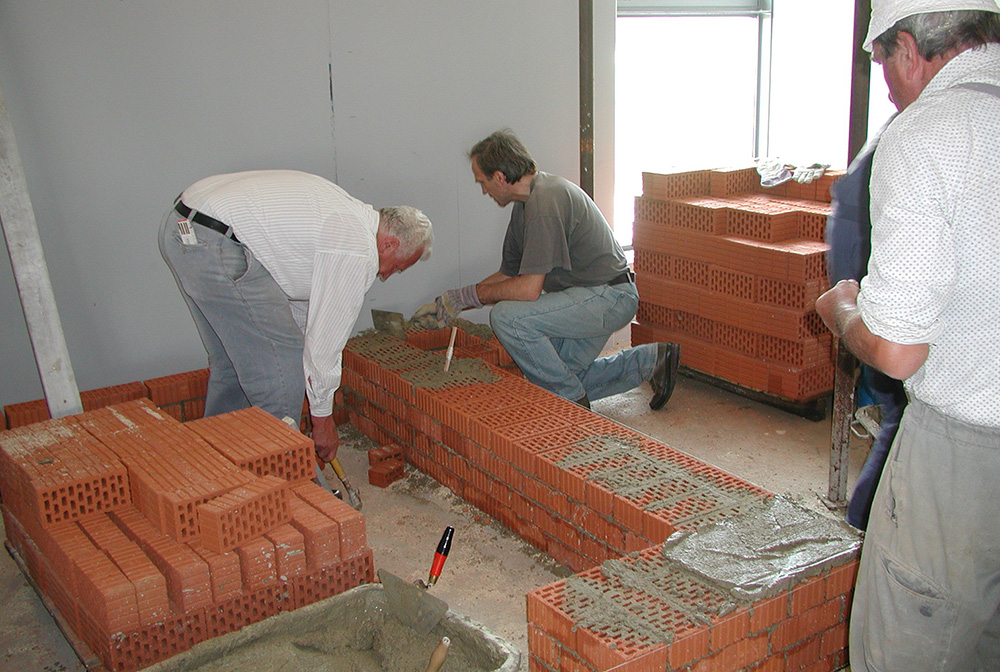
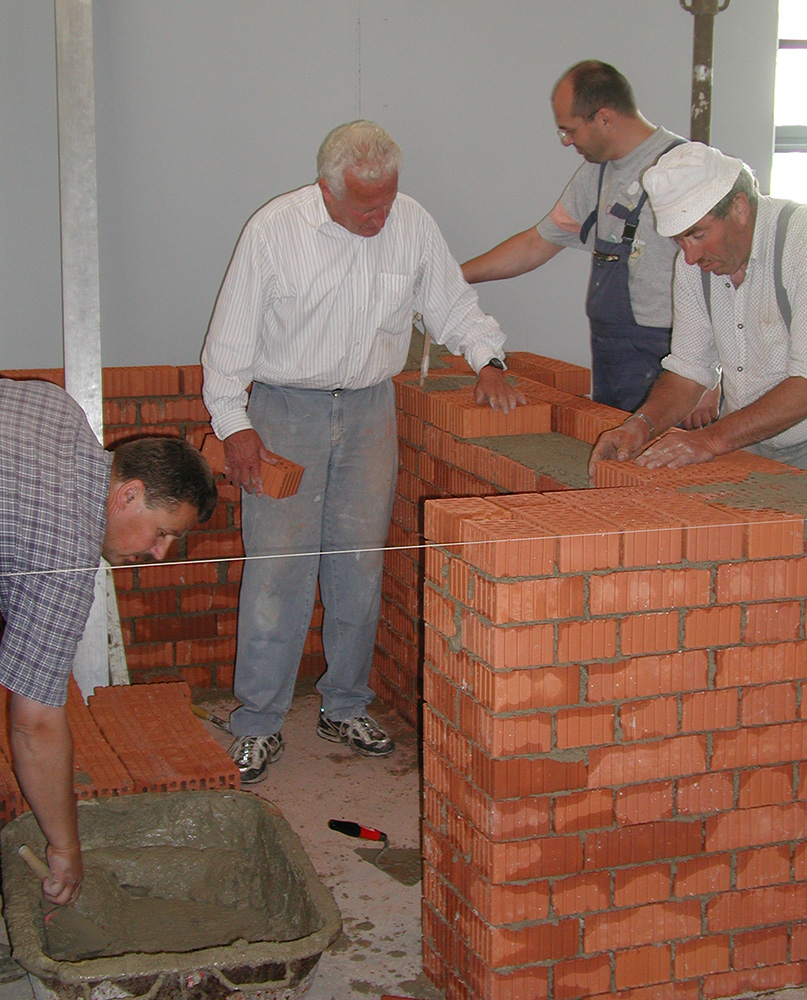
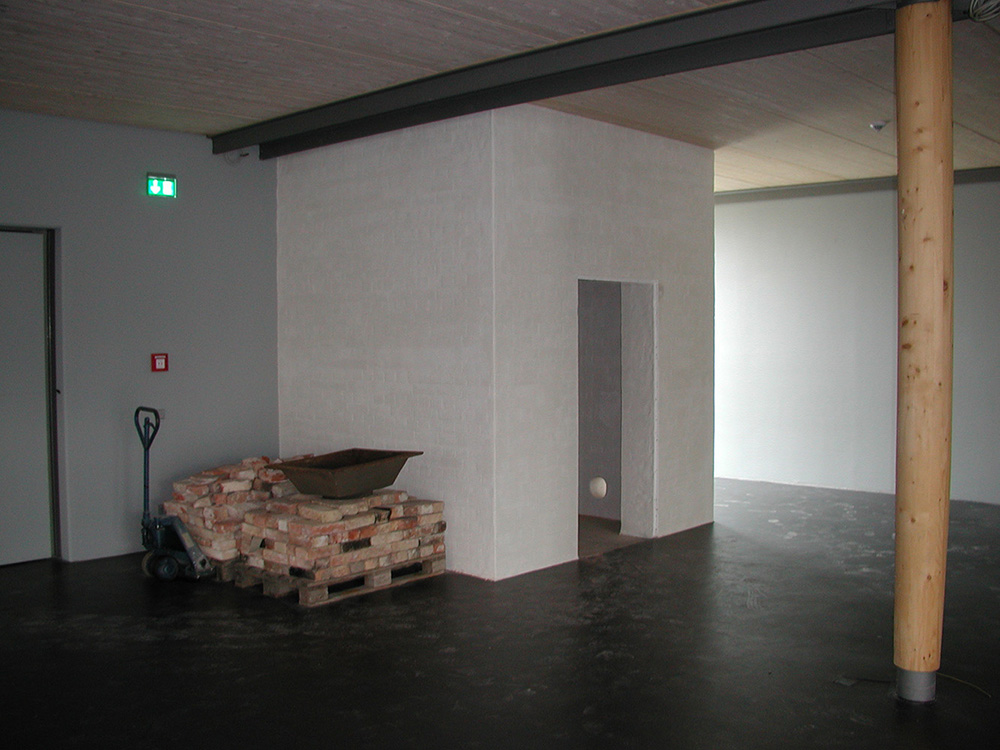
Today, there are probably no German kilns left in the Hallertau region. We were allowed to either photograph a few of the last remaining examples, which had long been decommissioned, or transport them to our depot, dismantled into individual parts. In one case, the bricks were even removed individually and saved. We then used these components to restore a German kiln in its original design for the museum’s opening in 2005. Just like in an open-air museum.
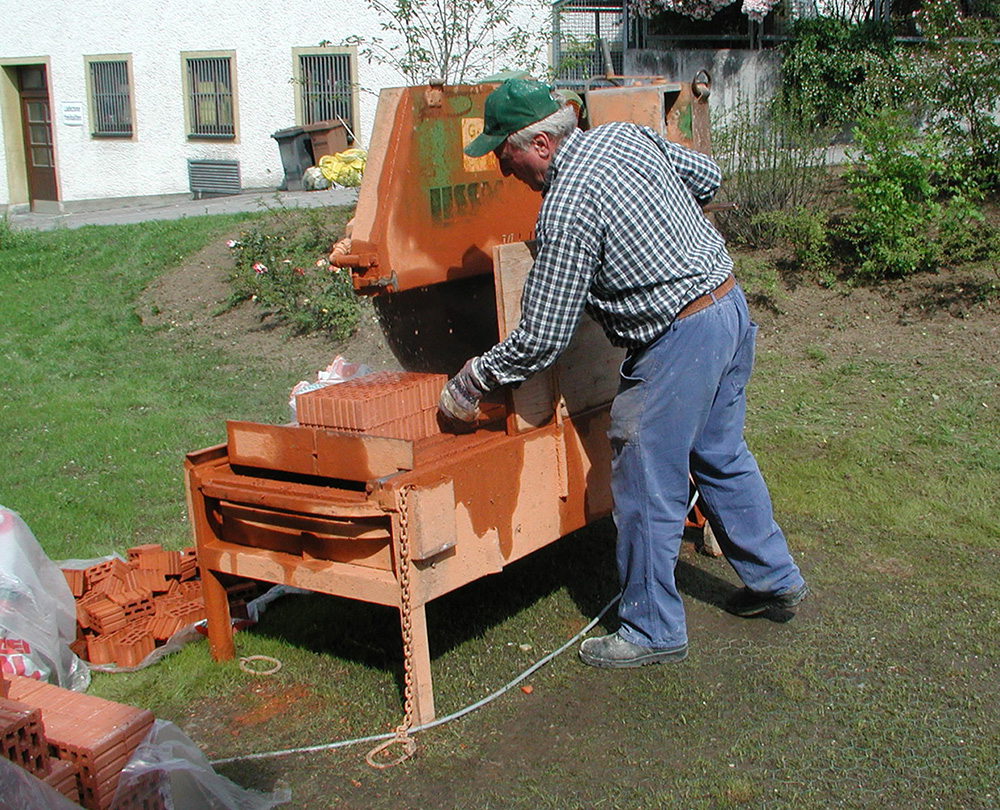
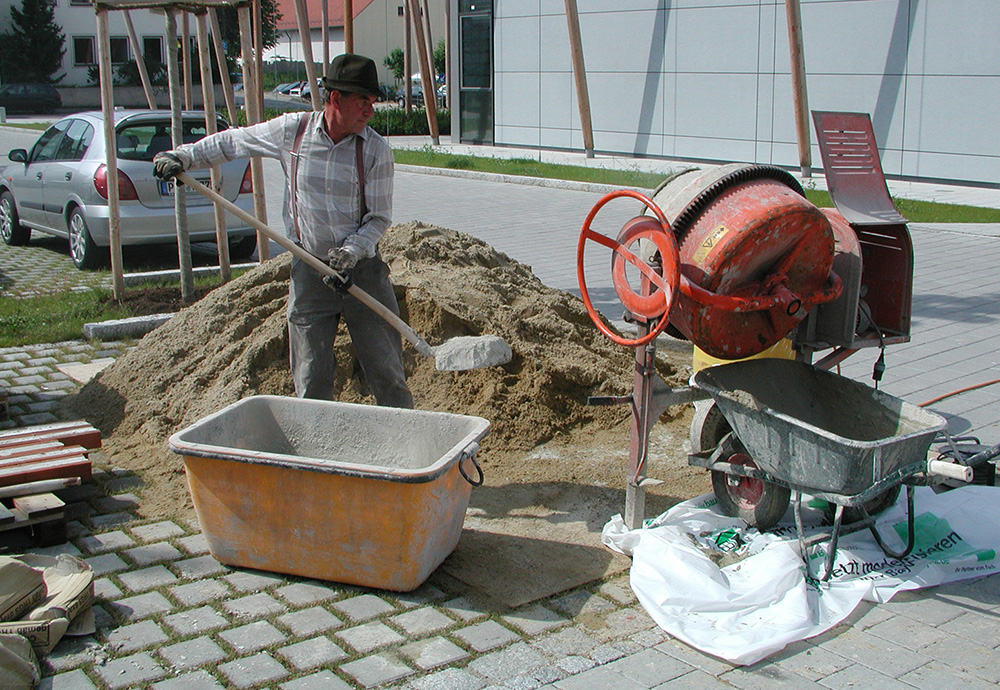
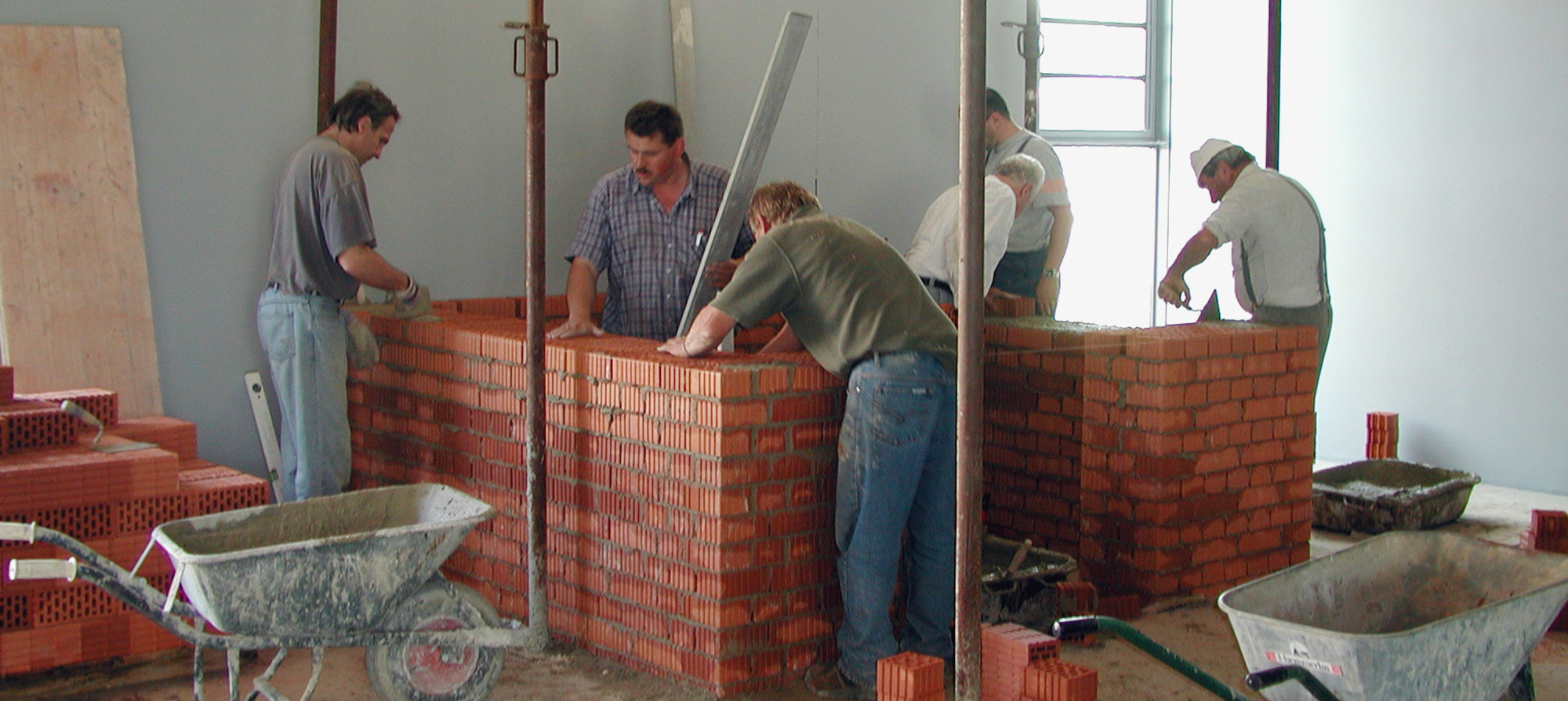
Incidentally, it was reconstructed and built by members and friends of our museum association, Deutsches Hopfenmuseum e.V., in their spare time. A true collaborative effort.