Every man his own hop farmer
For a long time, everyone in the Hallertau region grew hops
Every man his own hop farmer
For a long time, everyone in the Hallertau region grew hops
By Christoph Pinzl (Director)
Growing hops is something for farmers. Or so one might think. These days, there’s little to argue against that assumption. Anyone who still grows hops today manages a specialized agricultural operation and owns (or leases) extensive farmland where he could theoretically also plant corn, potatoes, barley, or St. John’s wort. In reality, however, many hop growers today do nothing else but focus exclusively on hops. Six-figure, sometimes seven-figure investments in harvesting machines, kilns, tractors, drying racks, blower sprayers, etc., etc., leave no room for any other business model.
But things used to be quite different. Even if it sounds funny: for a long time, farmers were more of a marginal group in hop cultivation. At least “real” farmers, who made their living solely from agriculture. Well into the 18th century, it was primarily the prince, baron, or count – in other words, the nobility – who dealt with hops. Ideally, this was done in conjunction with a house or family-owned brewery, so to speak, straight from the field into the brewing kettle. Alongside the rest of the estate’s operations, there were a few small hop patches somewhere nearby, covering just a day’s work, which were good for nothing else. That’s where the name comes from – hop garden: hops grew behind the fence, not in the field – a few hundred plants, that was all it took.
Around 1800, things started to get more interesting with hops. Breweries became more and more numerous and larger, and hops evolved into “green gold” that could be sold profitably – at least when the price was right. The year 1860, which has been mentioned several times, marked the start of the famous hop gold rush, which continued, with minor interruptions, until around 1890.
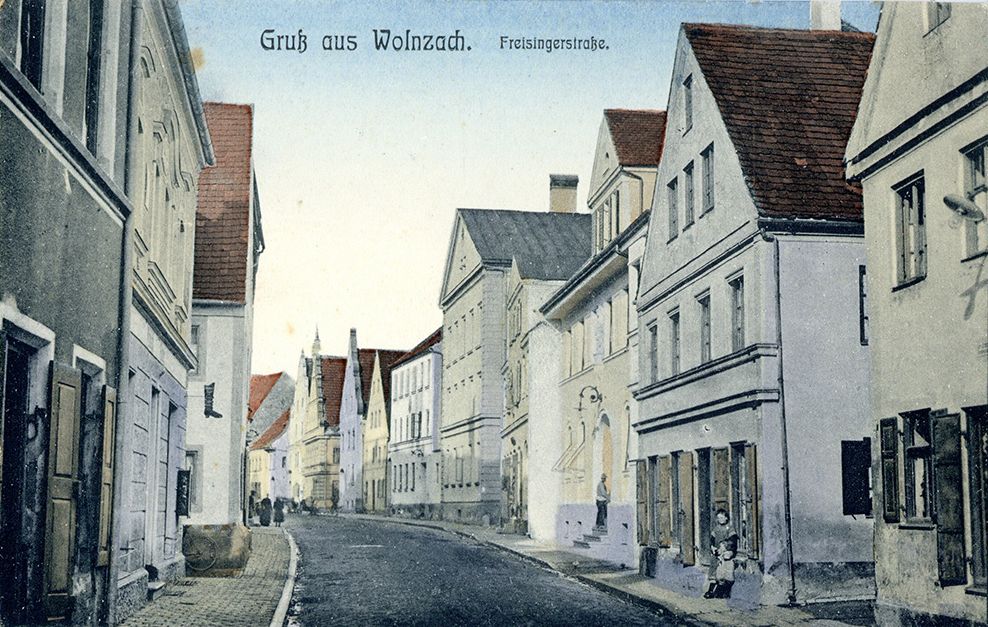
At that time, virtually every household was involved in hop growing. Freisinger Straße (now Preysingstraße) in Wolnzach, around 1910.
The property tax register for the market town of Wolnzach from 1862 reveals that at that time, practically every resident was a hop grower. From day laborers to teachers, from respectable craftsmen to trained doctors, from shopkeepers to pastors, everyone grew hops. Unlike today, one had to spend relatively little money to get in on the hop gamble. The hop poles came from the forest, plant protection was unheard of, the harvest was done with the family in the evening after work, and the hops were dried in the attic. Hops seem to have been particularly attractive to innkeepers, especially when the inn was right next to the in-house brewery. A third of the hop gardens belonged to beer-brewing innkeepers. Pure risk minimization: those who produced their own hops were largely unconcerned by the wild fluctuations in prices on the hop market. Unless, of course, the price curve shot straight to the top again: then the guilders were flowing.
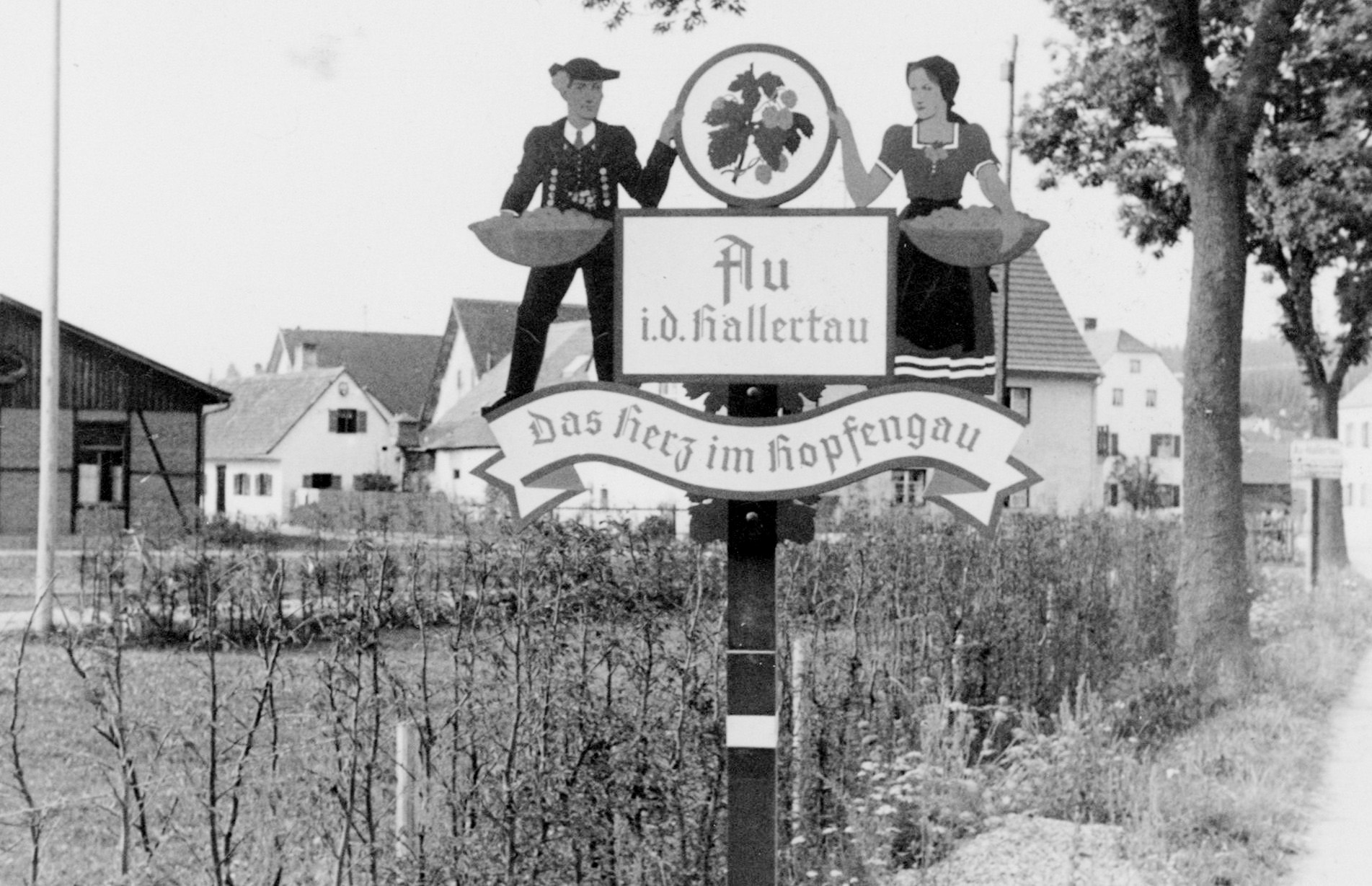
Despite all the upheavals, this basic structure remained largely unchanged for a long time. A study of the town of Au i.d. Hallertau from the 1950s yielded the following result: a mere 21% of all hop growers in Au were traditional farmers. In contrast, there were around 16% merchants and tradespeople, 19% laborers, a smaller percentage of civil servants, employees, and academics (including a dentist), and finally, at nearly 24% – the largest group – craftsmen. We even have quite detailed information about their professions: 8 masons, 4 butchers, 3 tailors, 3 carpenters, 3 shoemakers, 2 brewers, 2 saddlers, 2 locksmiths, 2 tinsmiths, 2 wheelwrights, 2 blacksmiths, 1 baker, 1 electrician, 1 pastry chef, 1 painter, and 1 watchmaker – all of these trades were present in Au at the time. And all of them also tended to the hops on the side. Among the merchants, we find grocers, coal dealers, sawmill owners, shoe store owners, hardware dealers, hop dealers, freight forwarders, and even a furniture dealer. Of course, the innkeepers were also among them. All of them were also hop growers on the side. Unfortunately, we do not know whether women were represented in any of these professions. A distinct group of earners consisted of people who were already receiving a pension from somewhere else and supplemented it with income from hops.
Of course, the majority of the hop gardens around Au were cultivated by the aforementioned fifth of pure farmers. Farmers who were also hop growers tended to cultivate hops on a larger scale. However, they usually did not use even a fifth of their agricultural land for this purpose. After all, the monocultural conditions of today were still a long way off. Back then, a farmer who grew hops also harvested grain, root crops, and vegetables, drove his livestock to pasture, and tended his forest. On the other hand, there were some among the craftsmen and merchants who used 100% of their agricultural land for hops. This made sense as long as prices cooperated to some extent.
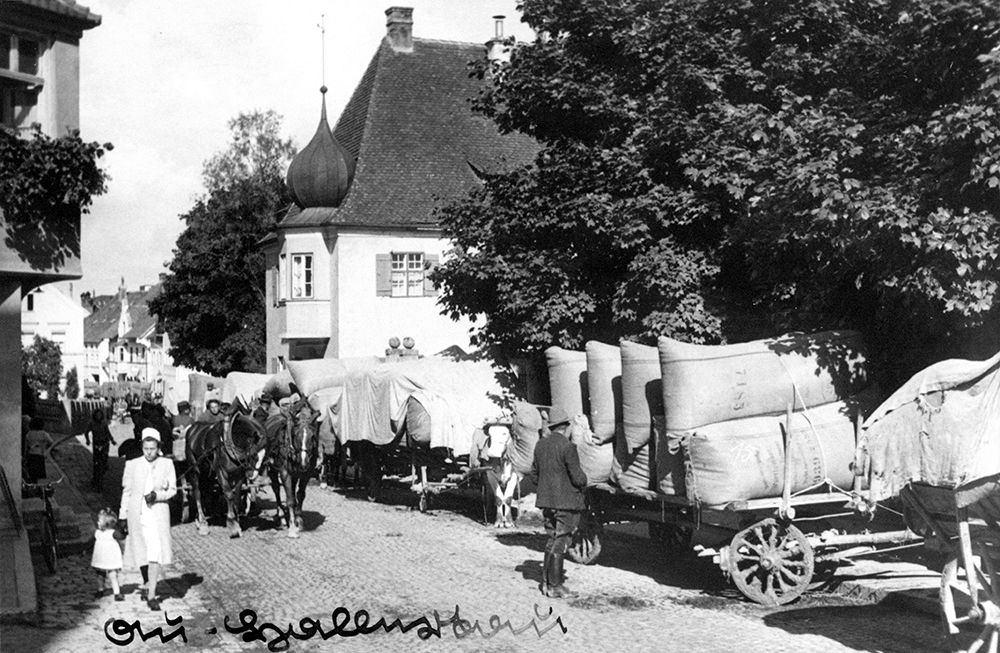
In the center of Au during the hop harvest, around 1939.
What such a structure meant for a region like Hallertau – for communal life, daily routines and festivals, ways of thinking and acting – would have provided material for several doctoral dissertations. But such studies do not exist. Sociologists and, above all, cultural scientists – formerly known as folklorists – would have found an exciting field of study here. But they didn’t really look for it. So today, the most one can do is ask the elderly residents of the Hallertau whether they still remember how life unfolded over the past 100 years or so.
What is clear is that everyone – men and women alike – was interested in what was happening in the hop gardens. In how the vines and cones developed over the course of the year, what was going on at the hop market, what the merchants paid, and what the competition was up to elsewhere. Even as cultivation gradually became more labor-intensive toward the end of the 19th century, when wire trellises and hop kilns became mandatory, when plant protection emerged in the mid-1920s, and when it gradually became increasingly difficult to find hop pickers: temporary solutions were always found. The neighbor’s children helped with the picking; the smallholder invested in a better sprayer and also treated the teacher’s garden; the old Bock Trellis and the old German Kiln – even though long technically obsolete – continued to serve their purpose; those who were skilled at string-hanging found a well-paid side job with less-skilled growers. And so on.
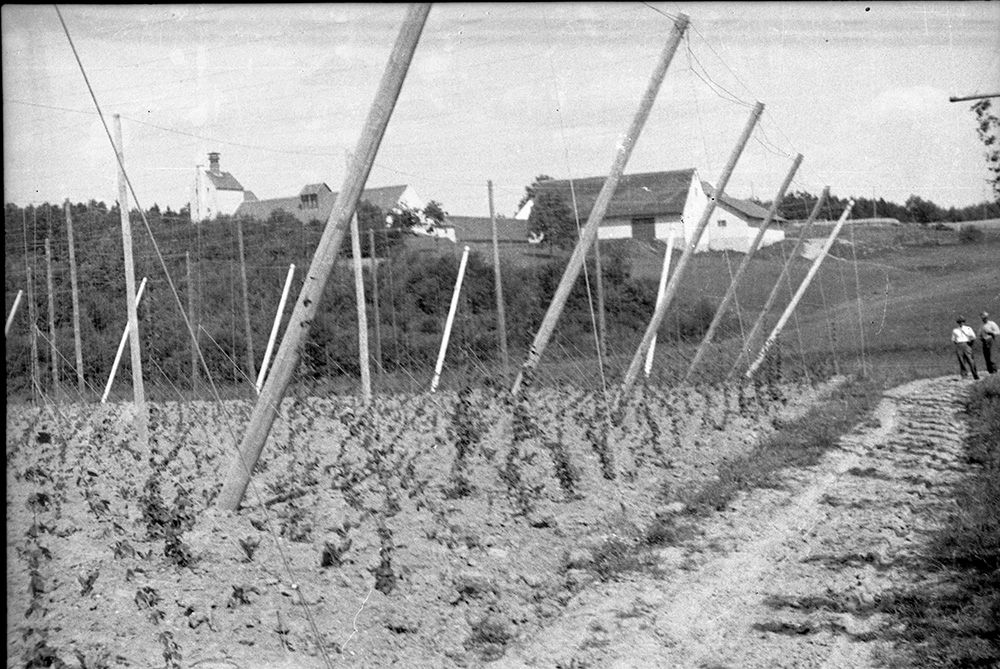
The introduction of hot-air drying and wire trellises around 1900 gradually turned hop growing into a field for specialists.
It wasn’t until the developments of the 1950s that the real upheaval came. At first, smaller operations tried once more to find a creative solution, wanting to operate one of the exorbitantly expensive picking machines together as a picking cooperative. A sort of small-scale machinery ring. Almost socialist in its basic concept. But after just a few years, the old days were over. Whether they were truly “good” is open to debate.
Whereas in the early 1960s there were still 160 hop growers in Au, by 2026 there is only one left. As long as the elders can still recount the former importance of hops in the area, people still remember the old days, back when everyone somehow made a living from hops. For now.