The Criminal Activities of the Hop Pickers of Spalt
A 1924 doctoral dissertation examined social conditions
The Criminal Activities of the Hop Pickers of Spalt
A 1924 doctoral dissertation examined social conditions
Over the course of the 19th century, some hop-growing regions expanded considerably. With them, so did the size of the hop farms. Anyone who cultivated more than 1 hectare could no longer harvest their hops alone, with the help of relatives or neighbors. They needed seasonal workers – hop pickers. Those who worked hard could earn good money here. Word got around. A distinct profession even developed: the migrant worker. From economically disadvantaged areas – as we would call them today – people traveled for months from one harvest to the next: from grain to fruit, then to hops, on to potatoes, and finally to haymaking. In addition to their wages, this also secured them room and board for a certain period of time.
Of course, this wandering wasn’t welcome everywhere. Those who spent their lives on the open road, stopping only here and there for a short while, were difficult to keep track of. The farmers didn’t really know who they were housing on their farms. In the villages, where everyone usually knew everyone else, these “outsiders” caused unease and commotion.

Gathering of hop pickers, the so-called “Saumarkt,” Spalt, ca. 1910
Furthermore, notions of law and order were quite different back then than they are today. Anything that did not conform to one’s own value system was “undesirable,” subliminally threatened one’s way of life, and was simply considered “criminal.”
From this perspective, a young right-wing candidate named Hans Horn wrote his doctoral dissertation in law at the University of Heidelberg in 1924. The topic: “The Criminality of the Hop Pickers of Spalt.” The end of World War I in the fall of 1918 brought catastrophic consequences for German society, including devastating unemployment. Short-term employment – including room and board – during the hop harvest had become highly attractive. The traditional hop pickers from Bohemia were no longer allowed to enter the country; after all, they suddenly came from an enemy nation, no longer from allied Austria. The new workers were still unknown. They often turned up in the hop-growing regions without prior placement and frequently made a shabby impression.
Horn’s approach is utterly unsympathetic. He does not seek to change the living conditions of the people he studies, but rather to protect society from them: “True, the majority of hop-pickers perished during the war and postwar period, and the old beggars and vagrants on the country roads have perished. But already a new form of vagrancy has sprung up from the ground. The hardship and unemployment of a defeated country are once again driving countless people to wander (…) The constant threat to property and person, the ongoing harassment of law-abiding citizens, and the extraordinary damage to our remaining national wealth caused by criminality and vagrancy compel us to eradicate these antisocial elements. The crime statistics on migrant workers and vagrants show us the sources that must be cut off.”
His method of choice was called criminal statistics. By collecting as much data as possible on the “delinquents” and compiling it on a comparative basis, one hoped to probe the sources of criminality, dry them up, and ultimately “eradicate” them. Whether this approach was fair, sensible, or compassionate did not interest Horn in the least. Nor did he care about the question of who, then, actually harvested the hops for the hop farmers.

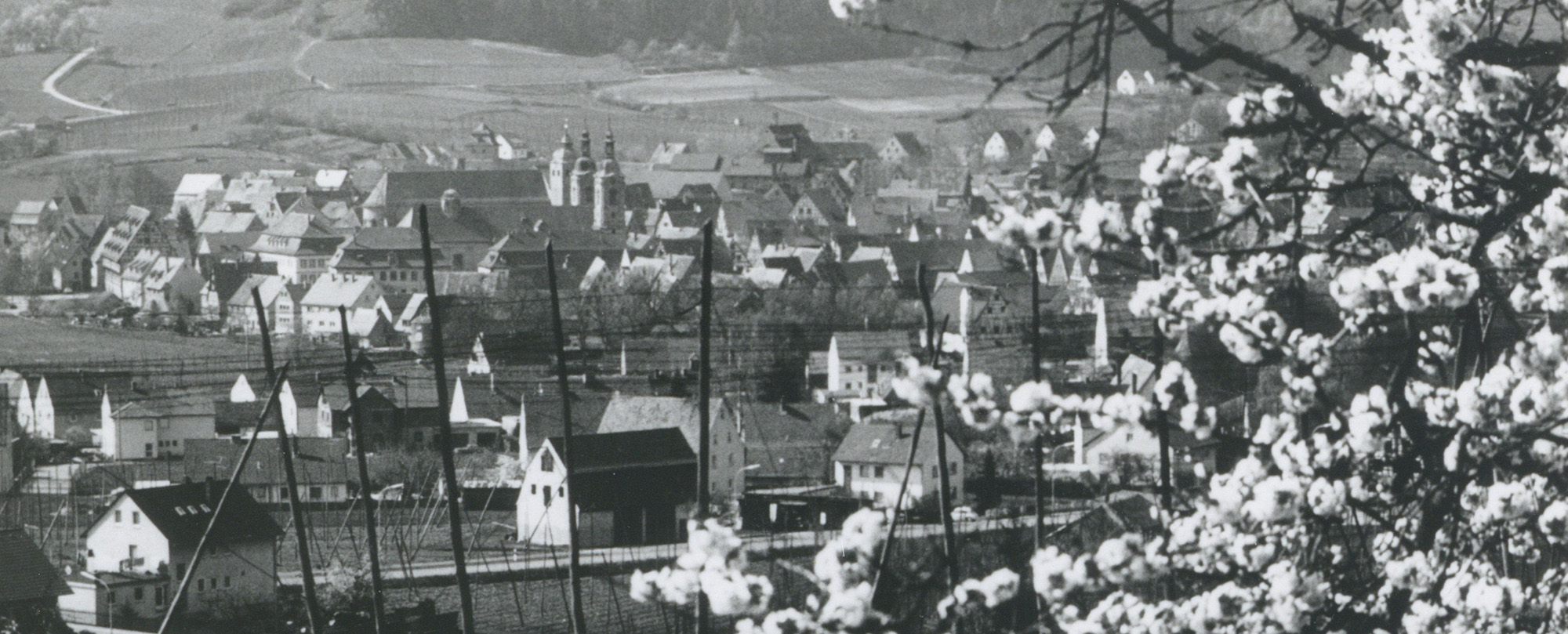
Cityscape of Spalt, ca. 1900
After a general discussion of the purpose of criminal statistics, the dissertation began with a brief historical review of the nature, causes, and development of what Horn called “migrant labor and vagrancy” – significantly, he mentioned both in the same breath. Fundamentally, “the course of human cultural development up to the present day” was for him “a process of gradual settlement.” Conversely, therefore, someone who was constantly on the move – for example, a migrant hop-picker – occupied a lower stage of cultural development: “The ultimate purpose of the migratory period is to settle down and acquire the means of production.” Professional migrant labor ran counter to this. “The geographical movement of vagrancy reveals the opposite: an antisocial pursuit of income without work; a neglect or complete destruction of the economic value of labor, and thus complete stagnation in the development of the individual’s economic personality.” In short: in his view, anyone who went to pick hops was hindering the development of civilization.
This is how Horn arrived at the core of his investigation. Page after page, he listed all manner of data on the hop-pickers registered in Spalt, ranging from their places and regions of origin to their age, gender, marital status, and occupation. Even at this stage, he drew connections to the supposed susceptibility to criminal behavior: were it more the young or the old, the married or the unmarried, the employed or the unemployed – who exhibited the higher level of “misconduct,” as he so aptly termed it in the jargon of the time? This was followed by a comprehensive account of the recorded “offenses” and “misdeeds” of all the hop pickers. What is particularly striking here is that Horn made little distinction between theft and assault on the one hand, and alcoholism, begging, insult, embezzlement, and what he called fornication on the other. Horn derived his data from statistical surveys conducted in 1911 and 1912 by the then-director of the Heidelberg Psychiatric Clinic.
In this way, Horn’s doctoral dissertation revealed a truly alarming susceptibility among Spalt’s hop-pickers to “criminal” behavior of all kinds. A full 54.1% of the male hop-pickers surveyed had prior convictions, 10.5% of whom had more than 50 (!) prior convictions. About 10% of them had already spent 2 ½ years in prison. The most common offenses were begging and vagrancy, which is hardly surprising. Among the female hop-pickers, “commercial prostitution” topped the list, which was to be regarded “undoubtedly as an antisocial phenomenon.” These ranged from the spread of sexually transmitted diseases to “serious moral harm,” whatever Horn meant by that. Next came theft and “property offenses of all kinds,” fraud, assault (which Horn closely linked to alcoholism), and finally all offenses against the state and public order, such as property damage or resisting law enforcement.

Hop pickers in a Spalt hop garden, ca. 1920
Horn’s crude classifications and distinctions of migrant workers into “occasional vagrants,” “craftsmen’s apprentices who do not seek work,” “work-shy individuals,” and finally “elite drifters (…), physically and mentally inferior individuals (…), who are either unable to work at all or at least not on a sustained basis,” are difficult to read today. In this respect, his remarks also appear as an intellectual precursor to what would eventually become the state norm in Germany beginning in 1933.
Whether Horn’s study led to any consequences for the Spalt city administration is not recorded. As a historical document, it remains valuable today despite its harshness.