The Last Hops
A Custom Marking the End of the Harvest
The Last Hops
A Custom Marking the End of the Harvest
By Christoph Pinzl
Despite its long history, hop farming has remarkably few rituals or elements of folk culture to offer. There is particularly little to be found in the realm of customs and festivals. There is no hop parade, no hop festival, no established initiation ceremony for young hop farmers, no special hop pilgrimages, hop blessings, and so on. What has existed for a long time, however, is a festive conclusion to the hop harvest – complete with typical customary elements, a set sequence of events, and a fixed cast of characters.
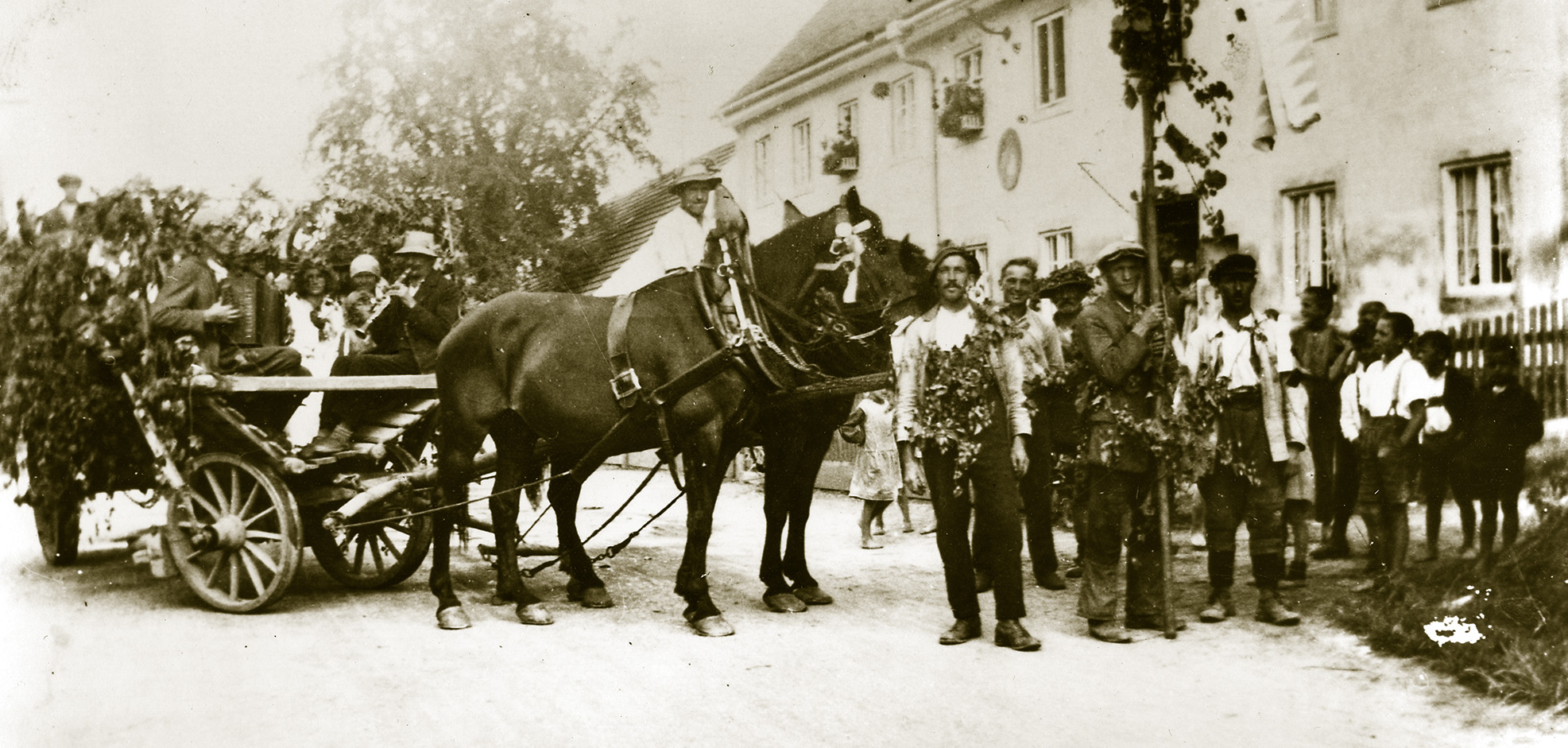
In the Hallertau region, the memory of a custom that centered on the last harvested hop vine has been preserved. This vine was wrapped (at least in the period after World War II), after it had been removed from the trellis in the hop garden, around a pole. This pole was usually that of the so-called “Stangler,” who used it to knock the vines off the running wire for the hop pickers in the hop garden. The pole and vine were then carried in a sort of procession to the farmyard of the farmer’s family.
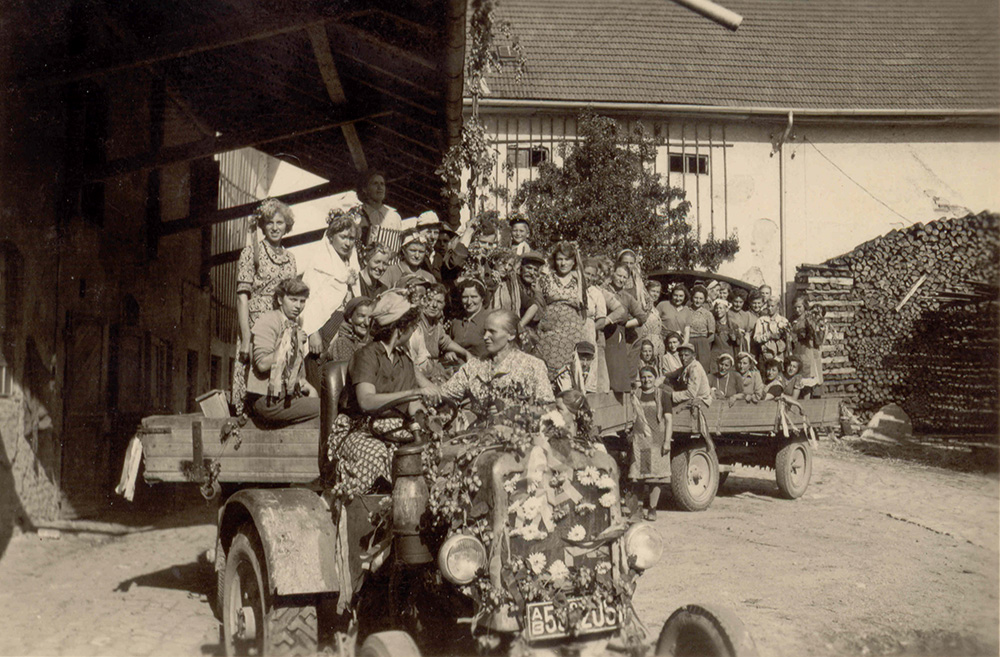
Ribbons and decorations on the (Lanz) tractor instead of on the draft animals, Wolnzach, circa 1950.
This custom has not been thoroughly researched. While there are a few essays on the subject, the custom has not always been documented in its entirety, and, more importantly, changes over the years have often been overlooked. Some details come from the stories of old hop pickers and hop farmers; others can only be gleaned from old photographs.
Individual elements could be added to the standard procedure. For example, the procession was sometimes accompanied by a figure called the “Hop Queen.” Not the one we still know today, who is elected at the Wolnzach Folk Festival in early August. It seems to have been mostly the picker who had picked the most hops, but sometimes it was simply a particularly pretty or popular picker who could be persuaded to play the role of the Hop Queen. In some accounts, one can also read about the “Hop Bride,” which apparently was nothing other than this Hop Queen. “Bride” was almost a better fit in this context, since she was often dressed in a white sheet along with a sort of veil. There was no crown, but often a wreath made of hop vines, which the queen/bride would wear. If available, she would sit on a wagon, on which other hop-pickers, along with the hop pole, were also allowed to ride. If there was no wagon, they simply walked. Whether the Hop Queen or Hop Bride subsequently had other duties to perform on the farm is not entirely clear. At some very large hop estates, she was honored by the farmer as the best hop-picker and/or given gifts. There is even a known case where she was subsequently “allowed” to perform a little dance of honor with the farmer. In Mainburg, there is said to have been a Hop King as well, who, along with this Hop Queen, was ceremoniously “buried” in the town fountain – whatever that was supposed to mean. Presumably, there were other variations as well. As mentioned, the custom has not been fully researched.
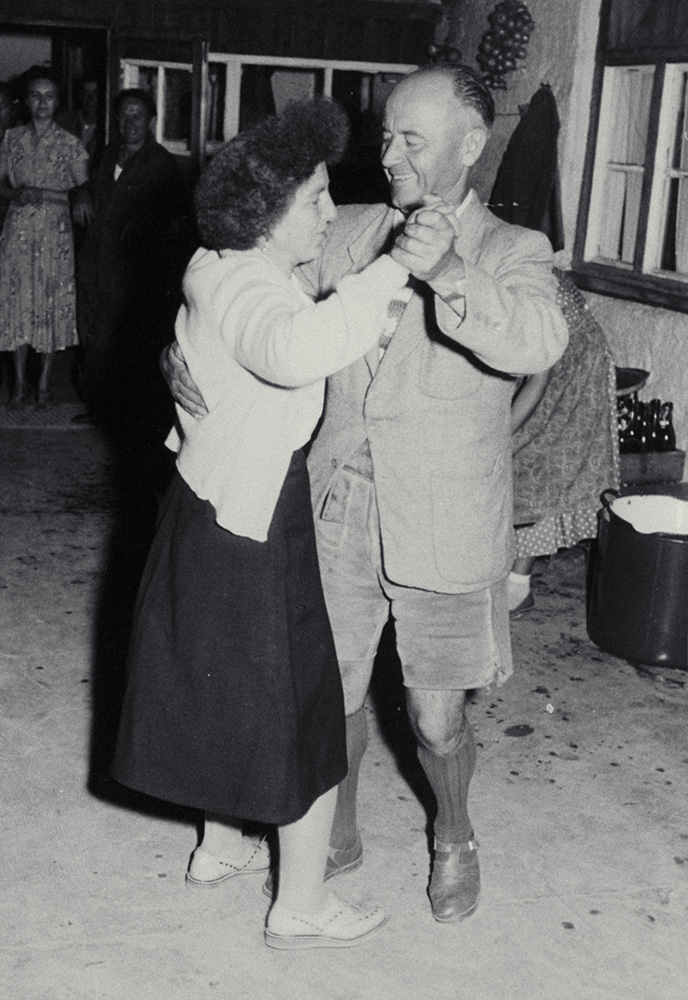
A dance of honor between the best hop-picker and the hop farmer, Au in the Hallertau, ca. 1950.
Depending on individual ambition, wagons and draft animals might have been decorated with vines and ribbons; other hop-pickers might have worn a hand-woven hop wreath; songs might have been sung on the way home, or musicians – if available – might have played, or the hop-pickers might have drummed on their empty baskets. Sometimes other people who weren’t directly involved in the harvest would join the procession as well – villagers, the farmers’ children, or farmhands. Here and there, one might also spot a homemade hop doll dressed in women’s clothing, sometimes referred to as the “Hop Mother” and attached to the top of the vine pole.
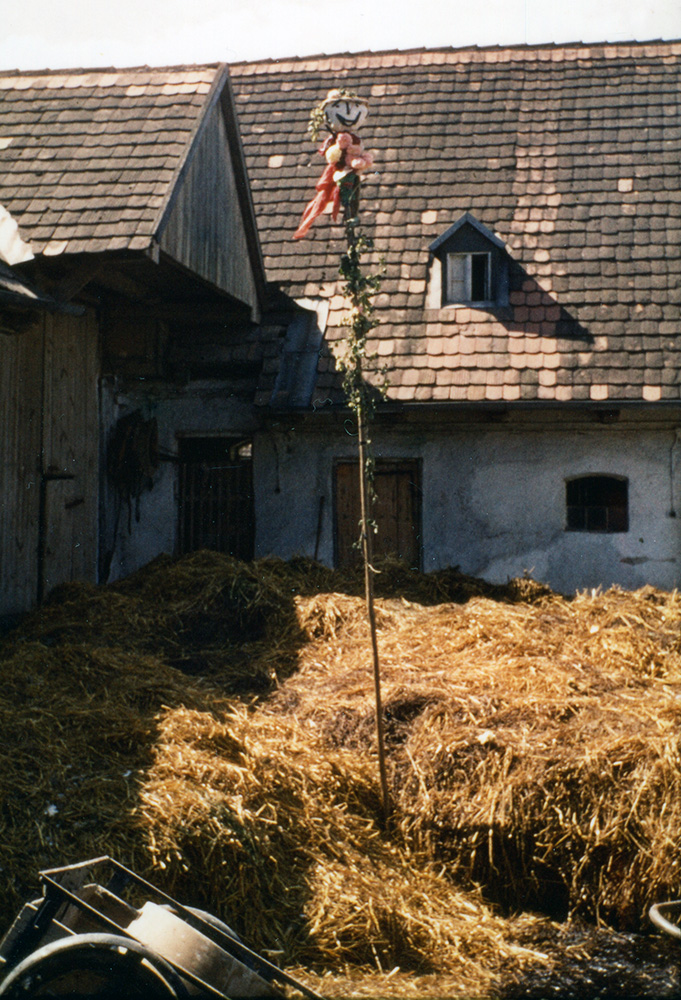
Set aside: A hop doll on the last hop pole stands out on the manure pile, Train, circa 1960.
Upon arrival at the farm – whether with or without a ceremonial speech, singing, or a dance of honor – the grand closing feast, the “Hopfenmahl,” (hop meal) followed in every case; in Franconia, this was usually called the “Niederfall.” Incidentally, the last hop vine was often referred to as “Alte”. The Hopfenmahl/Niederfall was usually followed by a sort of closing party with music and dancing, the style of which depended on the size of the farm, the presence of musicians among the harvesters, or the hop farmer’s willingness to hire musicians specifically for the occasion. The “Hopfenmahl” or “Niederfall” almost always took place, even without a ceremonial procession featuring the last hop vine. The term “Last Hop” could also refer simply to this closing feast, with or without music. As with all living customs, elements emerged in one place that never occurred elsewhere and then suddenly disappeared again; names and terms could vary, change, or differ from region to region.
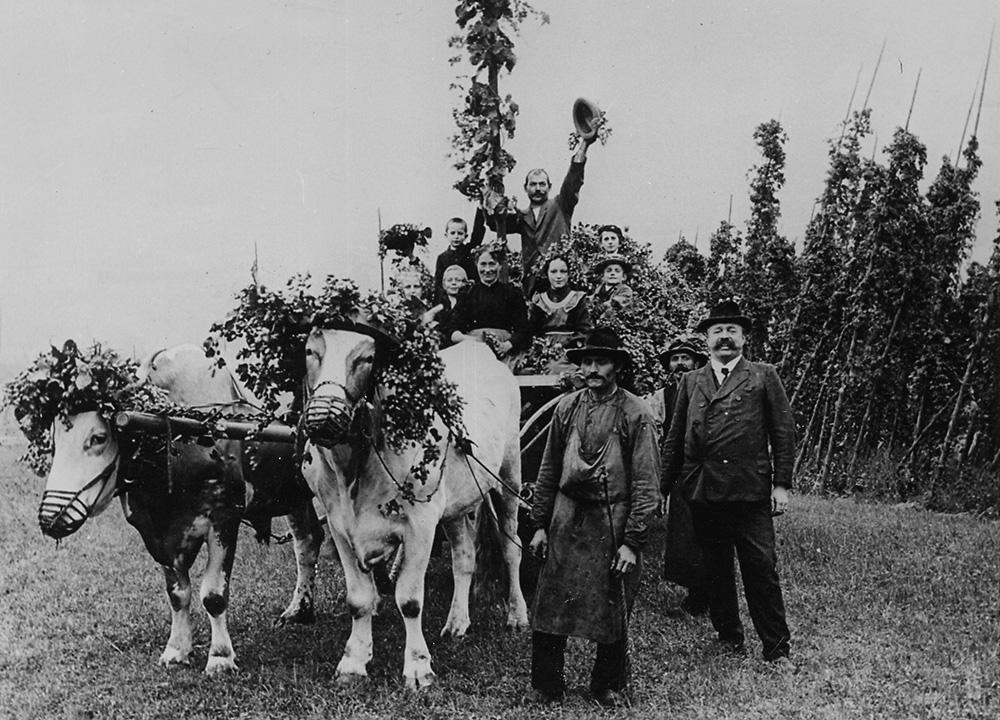
Last Hops in Hersbruck, circa 1900.
One particularly interesting element also appears only occasionally: a large hop wreath decorated with ribbons, made of hop vines and ears of grain. People would often attach it to the top of the pole along with the last hop vine, or they would simply carry it along. This wreath is so interesting because it points to the origin of the custom – regionally, chronologically, and, so to speak, “technically.”
This hop wreath almost certainly originated in Bohemia, specifically from Bohemian hop cultivation. There, the entire event was referred to as the “Hopfenkranz”, the hop wreath; apparently, there was never any mention of the “Last Hop” or the “Hop Meal” here. The elements – whether the queen, the pole, the decorated wagon, or the closing ceremony – were the same; only the name was different, and above all, the hop wreath seems to have been an integral part of the Hopfenkranz. That makes sense, in a way. However, the top of the hop pole was often adorned not with a wreath, but with a bedsheet repurposed as a flag. The hop wreath itself, on the other hand, was presented to the hop farmer. The Bohemian version also seemed to have a significantly longer tradition than, for example, in the Hallertau region. In Bohemia, the whole event also seems to have been much more staged, picturesque, and theatrical in nature. So much so that in 1833, the people of Saaz even staged a full-fledged hop wreath ceremony in honor of the Austrian emperor, who stopped by for a visit. It was a sort of exhibition, with the final hop vine presented before Her Majesty. This certainly must have had a significant impact on the nature of the custom.
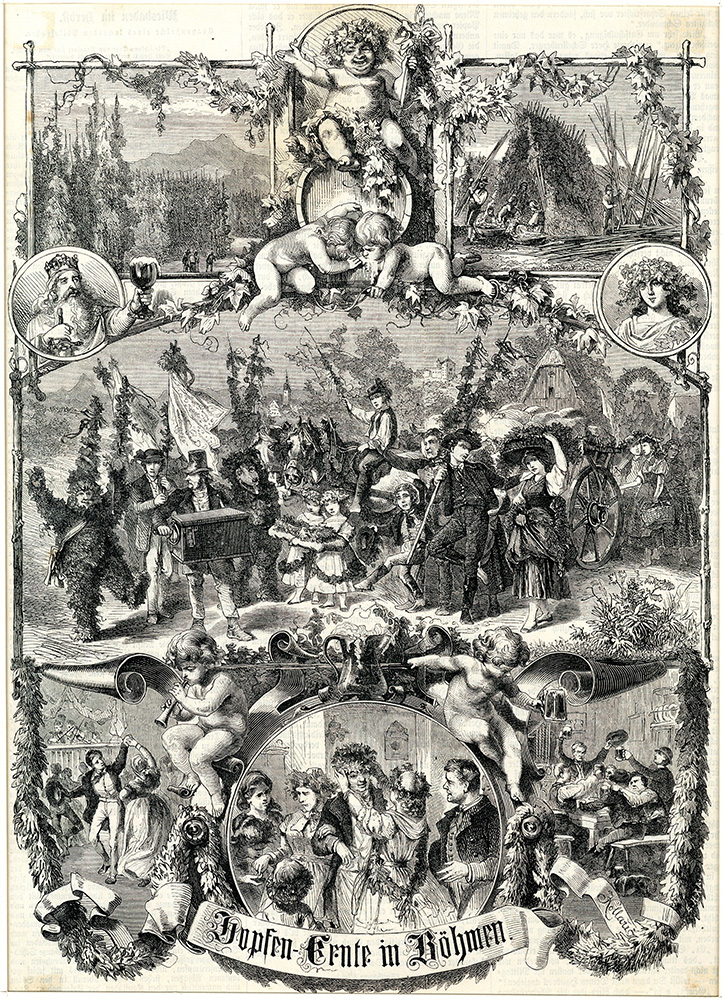
Hop Wreath Festival in Bohemia, 1868, lithograph by Franz Kollarz. Featuring a parade, the ceremonial decoration of the farm owners, and subsequent dancing and drinking festivities.
Given that the hop harvest in the Hallertau region only developed into an undertaking involving large groups of external harvest workers in the course of the 19th century, and that until the outbreak of World War I, a great many hop pickers came from Bohemia, it is no longer difficult to trace the origin of the “Last Hops” along with all its elements to Bohemian hop-growing and the local “Hopfenkranz.” The pickers had, so to speak, simply brought this tradition with them in their minds, shown it to the people of Hallertau, and the locals went along with it. Eventually, it became their own custom.
The Bohemian connection also clarifies the actual function of the custom. In particular, the pole wrapped in vines turns out to be a genuine hop pole – on which, as is well known, hops grew for centuries before wire trellises were introduced at the end of the 19th century and the vines began climbing upward along wires or strings. Here, the ceremonial procession bringing the last pole into the courtyard made much more sense, since that’s where the harvest traditionally took place before it was moved to the hop gardens with the advent of the trellises. As the poles gradually disappeared, the people of Hallertau and their hop pickers had already grown so fond of their last hop custom that they no longer wanted to do without it. The solution involving the pole of the “Stangler” was surely found quickly. And why not? Customs are allowed to change – that’s what keeps them alive.
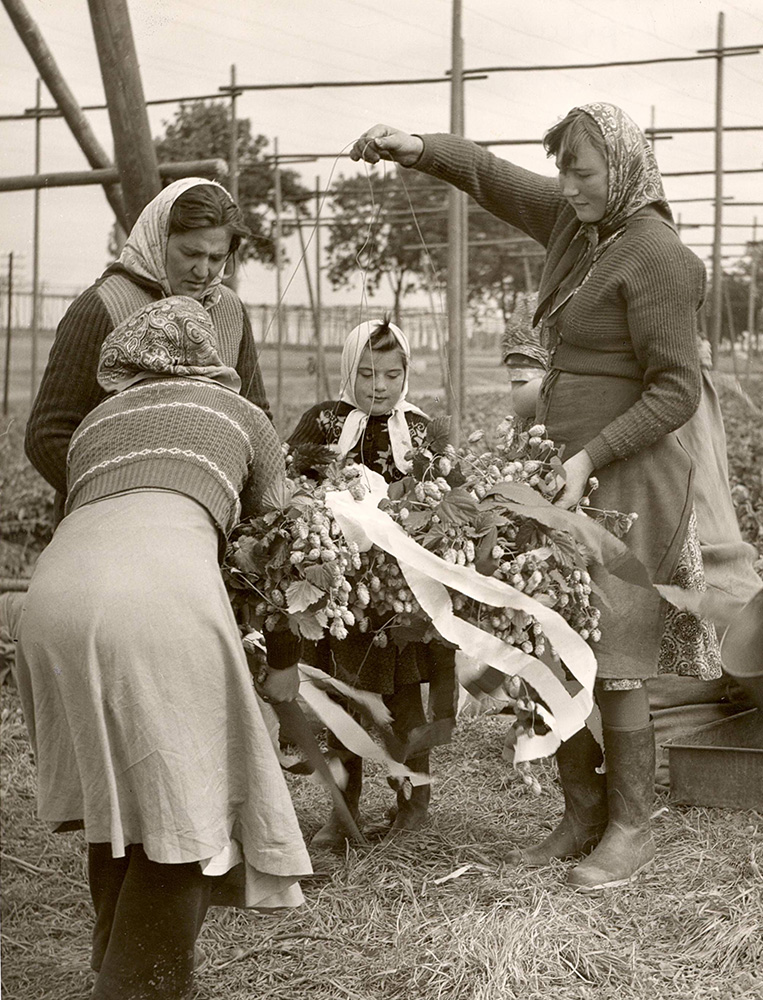
A hop wreath is being prepared, Hallertau, 1956.
Neither in the Hallertau nor in other hop-growing regions did the custom evolve into a performance that would eventually be attended, photographed, and consumed by outsiders, tourists, and spectators. This has greatly benefited the authenticity and vitality of the custom. Even today, after the end of hand-picking and the triumph of harvesting machines, the “Last Hop” still takes place from time to time. Today, of course, it’s more likely to involve a tractor, a chorus of honking horns, and a final photo taken with an iphone. This is a far more fitting form than if people were still to march around somewhat primly with a hop-picking pole, a hop bride and a hop wreath – and, due to the lack of active hop farming, were to stage the whole thing in the town square. Even if not much remains of the old elements of the custom. Consequently, there’s no need here for preservation or regulations governing the correct execution of the custom, as is often the case elsewhere – especially with customs that attract a lot of public attention. Should there one day be no more hops in the Hallertau or in Spalt, then perhaps the tourism industry will discover the “Last Hop” for itself after all. And then completely transform its function. Fortunately, though, we’re still a ways off from that.
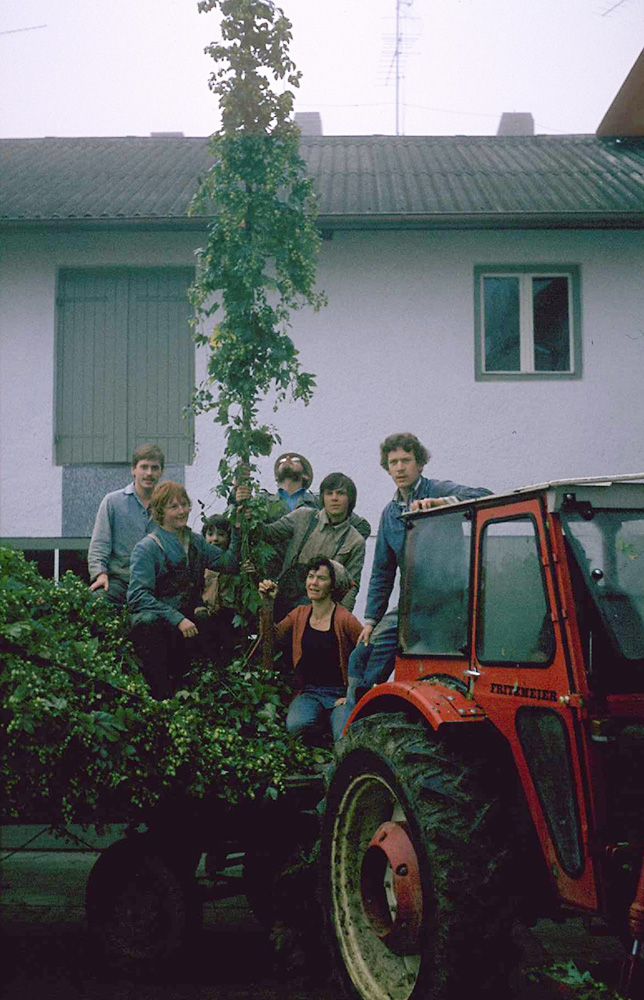
The Last Hops, including the pole, in the tractor age, Wolnzach, ca. 1980.
Hop wreaths still exist, of course. Today, however, they’re made by the local florist or by a hop farmer’s wife looking to earn a few extra euros. You hang them in your home until everything turns brown and starts to smell slightly cheesy. But such a wreath has nothing to do with the former harvest-closing custom anymore.