The Mystery of Marzill
A small village near Mainburg has made hop-growing history – presumably
The Mystery of Marzill
A small village near Mainburg has made hop-growing history – presumably
By Christoph Pinzl
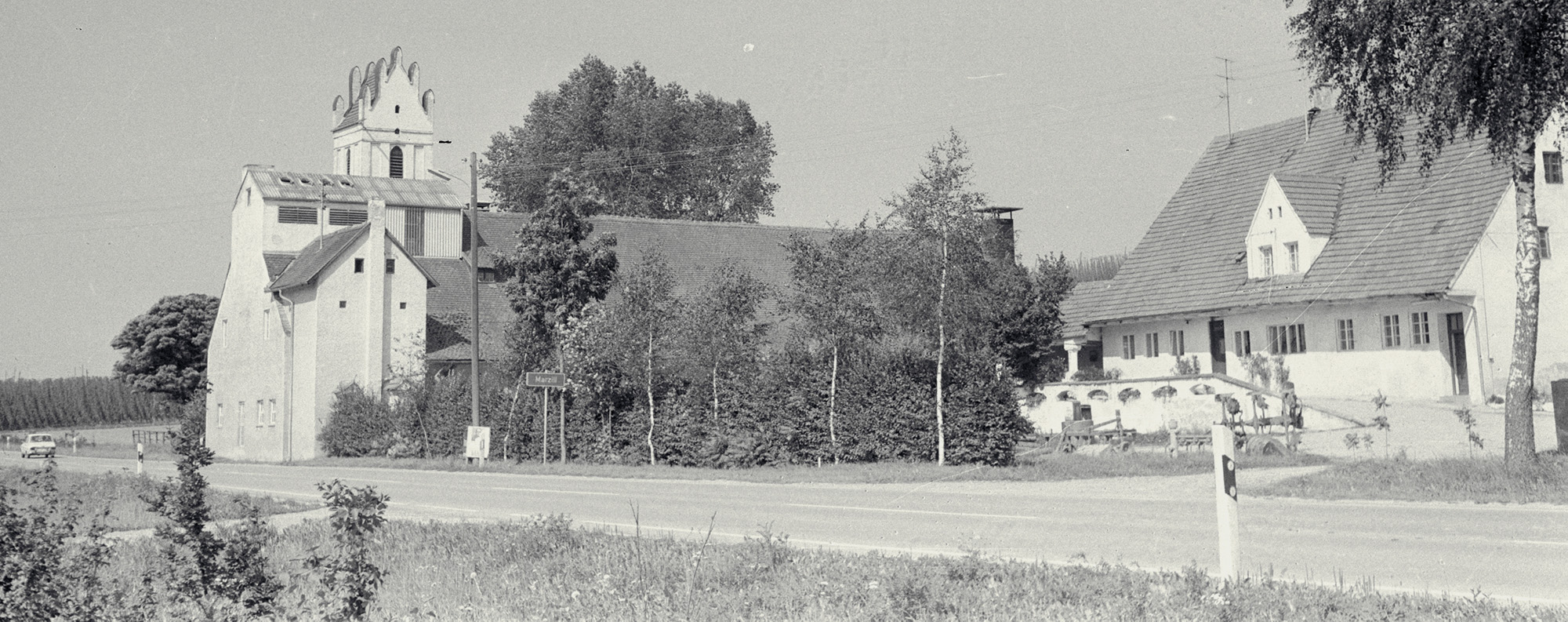
Anyone travelling today from the A 93 towards Mainburg – that is, on the road linking Wolnzach to Mainburg – will pass through Marzill. A small, unassuming village that really consists of nothing more than a single farm. The local church of St Wolfgang, with its unusually shaped tower, is a striking feature, visible even from a distance. What such a massive building is doing there is a mystery. It almost looks like the farm’s private chapel. Which is not the case.
That would fit in with the farm’s history, however. For that is at least as unconventional as the church building itself. And they certainly had the ambition to think big there. The ‘Gut Marzill’, as it was commonly known, took centre stage in the world of hops in the mid-19th century. In 1866, the English hop trading firm Wigan (later Wigan & Richardson) acquired the estate and began cultivating hops there on a grand scale. Ultimately, this covered an area of almost 40 hectares – an exorbitant figure for the time and virtually unrivalled in the Hallertau, indeed in the entire German hop-growing world. The army of hop-pickers must also have been immense; there was talk of several hundred seasonal workers. The deal had been brokered by the estate agency of the Nuremberg hop merchant Jakob Gutmann, who had been selling the Hallertau’s ‘green gold’ all over the world for years. Gutmann appears to have managed the business on site in the early years, as he is initially listed as the ‘landowner’. In the years that followed, responsibility for the hop estate also lay in the hands of stewards, though these were then mostly from the Kingdom.
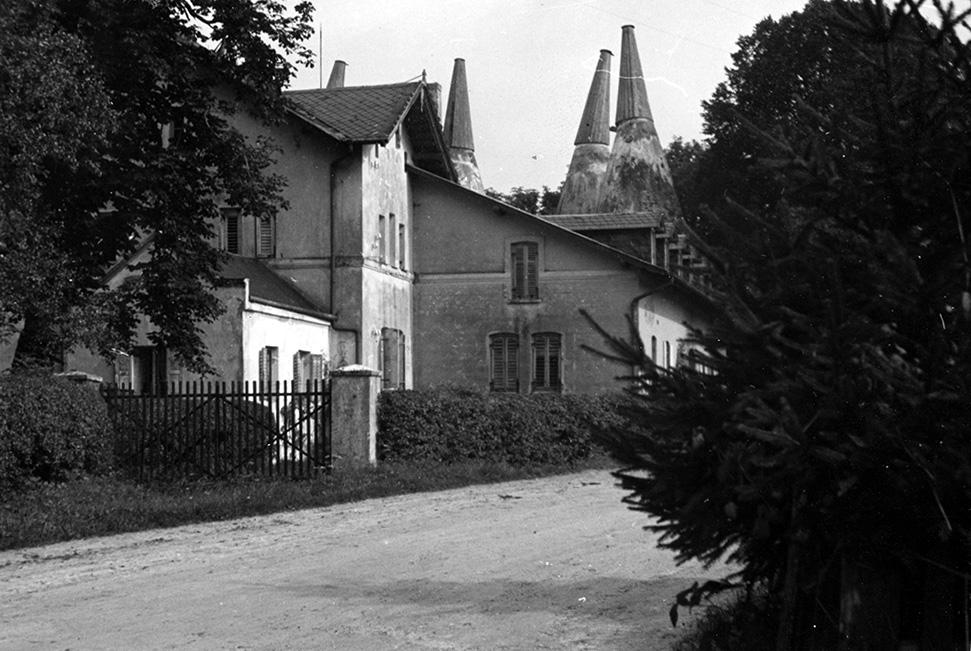
The ‘English hop hall’ in Siegenburg, 1940…
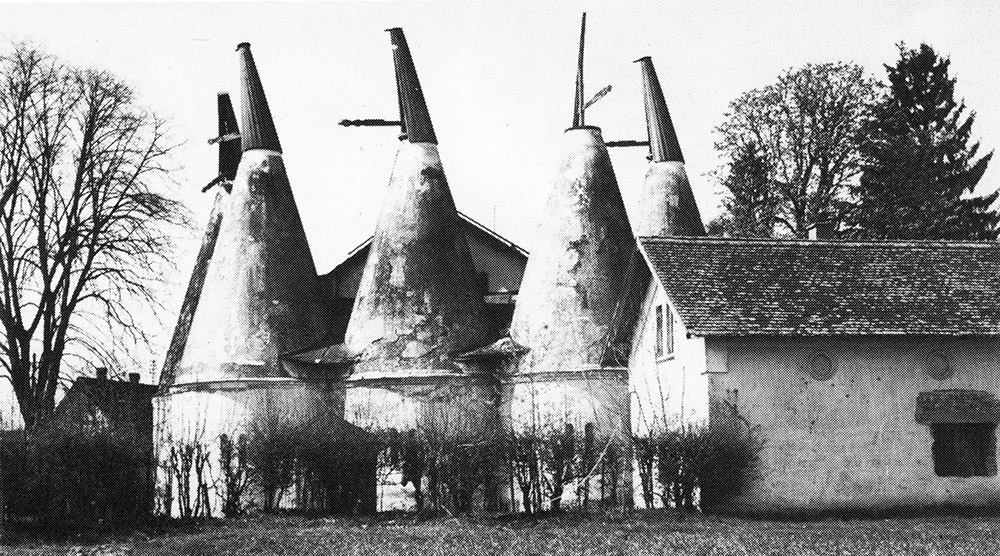
…and 1952.
It is not entirely clear what exactly the English were aiming to achieve with their purchase. Hops from the Hallertau were on the rise, without a doubt. The ‘golden year’ of 1860 had brought spectacular prices, and the burgeoning Bavarian brewing industry played a major part in spreading the reputation of local hops throughout the world.
But the Hallertau was still a long way from the global significance it would later attain. Good hops were grown in many places at that time. Competition came not least from England – precisely where the new owners of Marzill came from. So why not simply acquire a large estate at home and grow the coveted hops there? It was also particularly odd that they did not grow Hallertau hops in Marzill, but English varieties instead – ones that nobody in Germany wanted. One even had a special name, the Marzill Golding, which was reportedly only harvested once it had turned almost red. So, growing English hops abroad, allowing them to become overripe, and then going to great lengths to transport them back home – what was the point of that?
A later investigation claimed to have discovered that the people of Marzill weren’t actually necessarily after their own hops at all. In fact, it was supposedly mainly about purchasing inferior – and therefore cheaper – produce from the surrounding area, which was then peddled to the brewing world at a premium as genuine Hallertau hops. But to go to all that trouble to run a huge farm abroad just for that? It doesn’t really sound plausible.
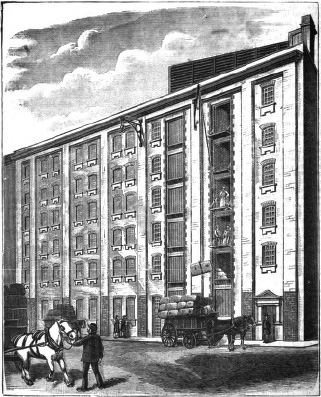
Hop cold store by Wigan & Richardson in London, 1899.
Whatever may have driven Wigan & Richardson, their Marzill estate developed in the years that followed into a flagship for modern hop-growing. Around 1880, ‘modern’ meant heated drying kilns instead of air-drying, mineral fertilisers instead of livestock manure, harvesting in the garden rather than at home, carried out by paid seasonal workers rather than neighbours and servants, and soon also wire trellises instead of pole cultivation and coconut fibres instead of guide wires. The latter seems to have been sorely needed, for around 1875 – with ‘only’ 10 hectares of hops – the demand for hop poles had already reached a staggering 91,000. These were all things of which the local Hallertau hop growers had scarcely heard anything until then. Now, however, word of the British innovations spread like wildfire. And everyone with even the slightest connection to hops made a pilgrimage to Marzill to see the new methods for themselves. There was talk of hop yields twice as high as was usual in the Hallertau. People wanted to see that for themselves.
The scientific community also paid a visit. Whether at the newly founded Brewing University in Weihenstephan, the Bavarian Agricultural Association or the German Hop-Growing Association: everywhere, a trip to Marzill soon became a must. As early as 1873, people were admiring innovations there such as impregnated hop poles and wide planting distances to allow for work with draught animals rather than by hand.
However, we no longer know exactly what happened in Marzill, and above all, what impact the whole affair had on the farmers of the Hallertau. One of the most important sources for this was handwritten records which could still be found in Marzill in the mid-1970s. These, however, no longer exist today. Presumably they were thrown away whilst clearing out the attic – who knows. This is one reason why public archives and their guidelines exist.
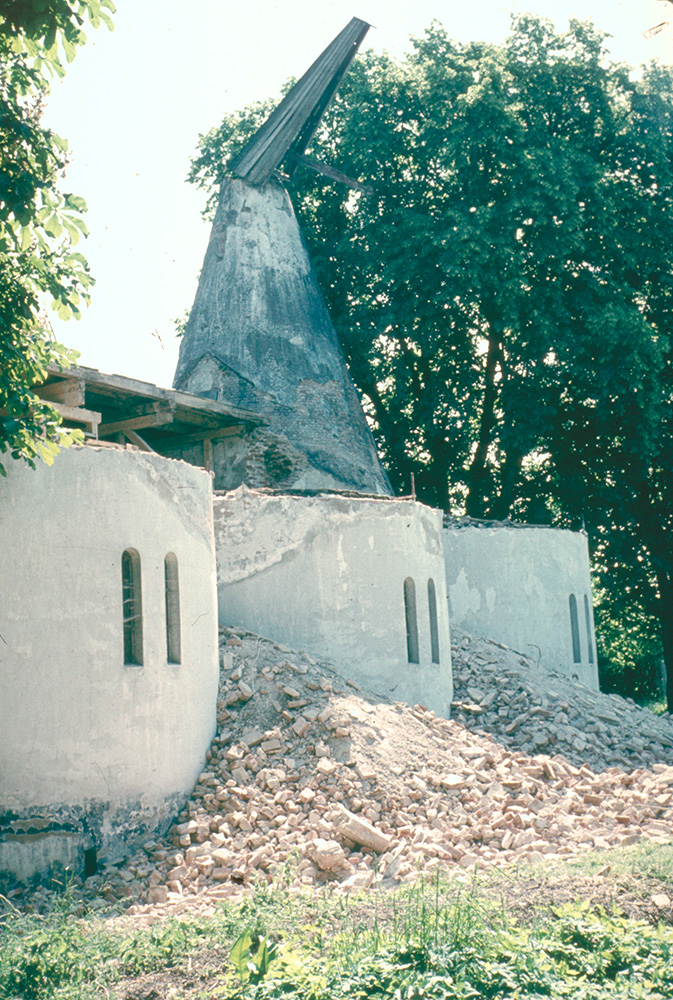
Remains of the demolition of the Wigan & Richardson hop hall in Siegenburg, c. 1980.
The greatest mystery was created by the English in Siegenburg. There, Wigan & Richardson built a large hop hall featuring no fewer than five English-style hop kilns. Bizarre, pyramid-shaped structures that remained an exception in the Hallertau region. Supposedly to dry the hops harvested in Marzill. The 22-kilometre journey from Marzill to Siegenburg by cart took half a day back then. Sending the delicate hops all the way across the region for so long made absolutely no sense. So what really happened in Siegenburg? Was the ‘poor-quality’ Hallertau hop processed there – through further drying and sulphurisation – until it was transformed into the ‘high-quality’ Marzill Golding, as was later often claimed? On the other hand, there is no initial mention of a hot-air kiln in Marzill. The many hectares of hops had to be dried somewhere. As I said, it’s all very mysterious. The same goes for details regarding the construction of the Siegenburg drying kilns. No precise plans survive.
Whether it was cheap Hallertau hops, home-grown hops, or Hallertau hops processed to resemble home-grown varieties: the whole Marzill operation is said never to have been profitable for the English in any case. Which seems rather odd given a commitment spanning almost 50 years; even the most successful hop merchants at the time could not afford to give anything away for free. In 1875, there was still talk of an annual profit of 45,000 guilders – ‘unprofitable’ sounds rather different.
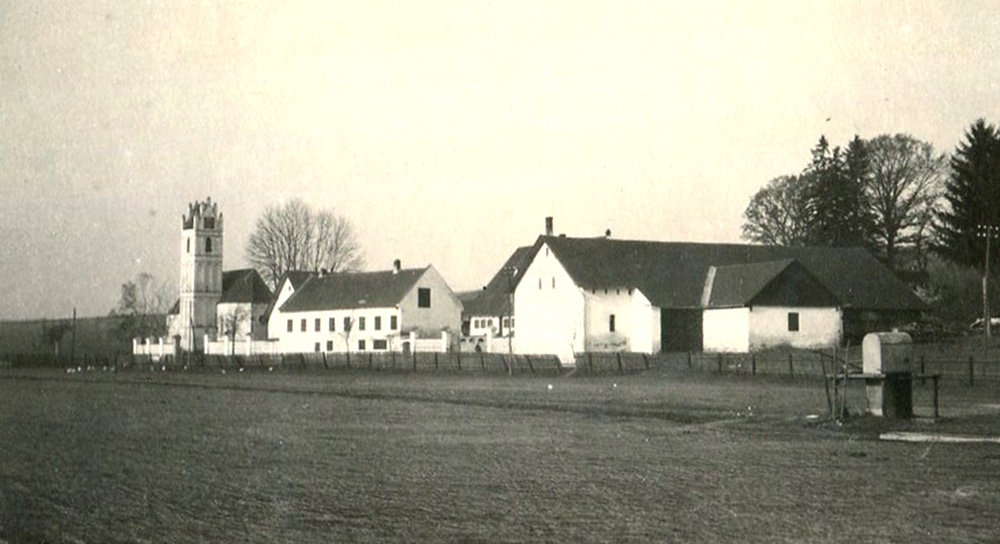
Marzill Estate, 1921.
It all came to an end in 1914. The First World War declared the English to be enemies. Marzill was summarily confiscated. By that time, however, Wigan & Richardson had already lost interest in Hallertau. With the purchase of a huge hop farm in Oregon, they had already shifted their focus to the USA in 1912 – the new hotspot in the world of hops. The “Wigrich Farm” there was at one time considered the largest hop estate in the whole world and continues to exist to this day under a different name.
After the end of the war in 1918, a “Battle for Marzill” raged for years between government authorities and prospective buyers. This episode is the only one in the history of the Marzill hop estate that can be traced through archival records. Joh. Barth & Sohn (now BarthHaas), hop merchants from Nuremberg, made efforts to acquire the Marzill estate for a time in the 1920s, but ultimately purchased the nearby Barthhof instead. Eventually, the Marzill estate passed into the hands of a local farming family, who still run it today. However, they no longer grow hops there.
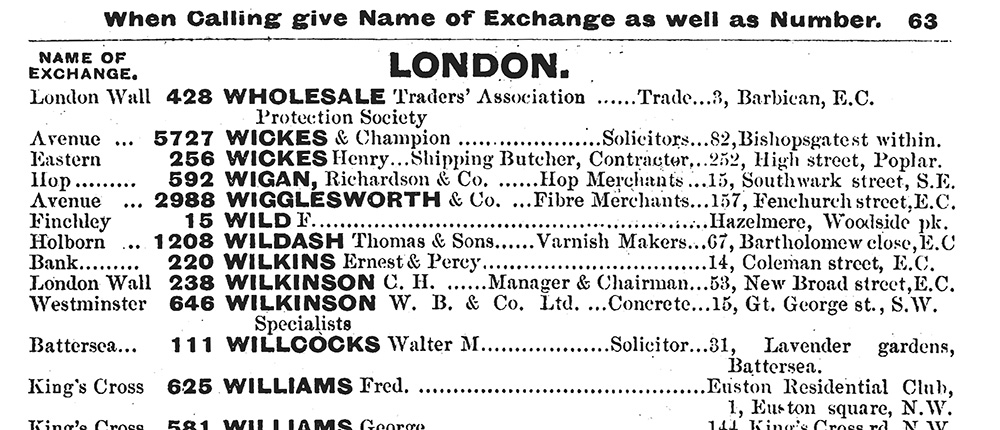
London address book from 1899 with the entry for Wigan & Richardson at 15 Southwark Street.
In the 1960s, a link between Wigan & Richardson and the Barth company did eventually materialise. The latter acquired the English firm – which by then was no longer quite as successful – and incorporated it into its trading house. Yet although there has always been an interest in Nuremberg in preserving historical sources for posterity, an old company archive of Wigan & Richardson is nowhere to be found today. Nor, therefore, are there any records of what once took place in Marzill.
Marzill may well have played a role that cannot be overestimated in the development of the Hallertau into the world’s largest hop-growing region. At any rate, this is what is claimed in some quarters. We are unlikely to be able to prove it today. A few documents still lie dormant in an archive in central England. It is doubtful whether they will bring anything new to light. The mystery of Marzill will probably remain unsolved forever.