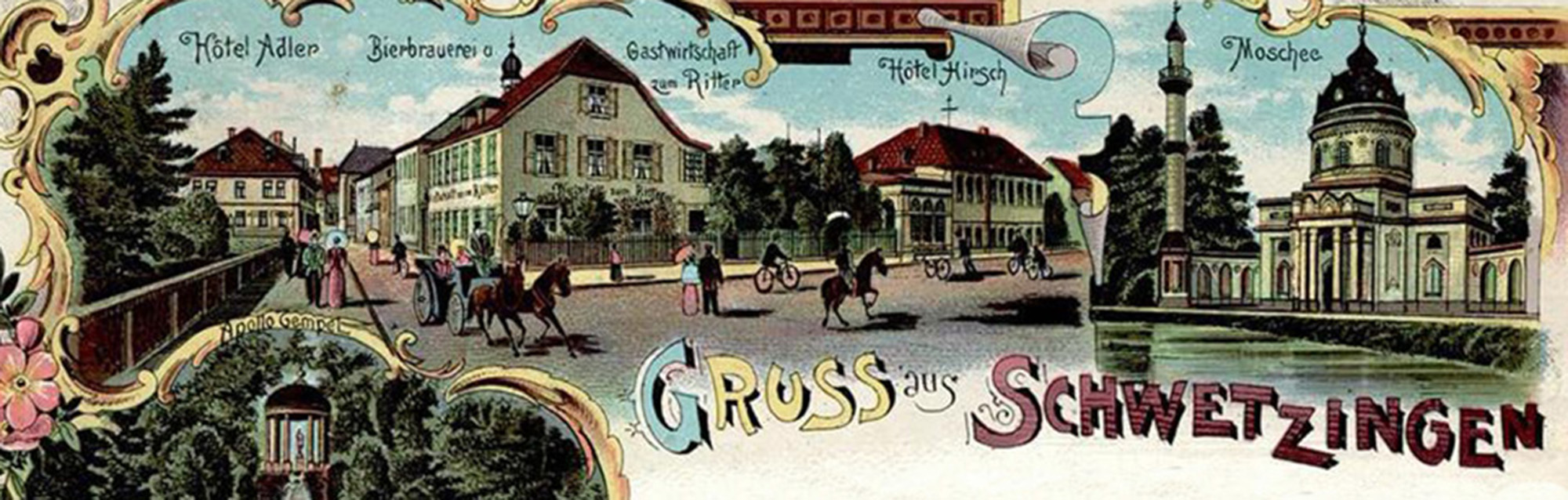
Into the Hop-Drunk Town
How a Naturalist from Schwetzingen Experienced the Hop Gold Rush
Into the Hop-Drunk Town
How a Naturalist from Schwetzingen Experienced the Hop Gold Rush
By Christoph Pinzl
Hop cultivation had existed since the early Middle Ages, with the first records in Germany dating back to the 9th century. But hops only really became interesting in the course of the 19th century, as more and more breweries brewed ever-increasing amounts of beer, which ever-more people in the growing cities wanted to drink. During this period, cultivation began to flourish in the hop-growing regions still known today, such as Hersbruck, Spalt, and the Hallertau. In Tettnang, it was just getting started at that time. But these were by no means the only regions in Germany that wanted to profit from the new hop boom. One was the Grand Duchy of Baden, newly founded in 1806, and here, in particular, the city of Schwetzingen.
Schwetzingen had long been under Palatinate rule. Elector Karl Theodor of the Palatinate had his summer residence built there in 1742. This was the very same Karl Theodor who, starting in 1777, also became Elector of Bavaria and thus founded the later line of Bavarian kings, including Ludwig II.
Whether this particular Bavarian connection led to a veritable hop craze breaking out in Schwetzingen around 1850 remains to be seen. In any case, the first hop garden there was not established until 1808. There was no trace of a tradition of hop cultivation, such as had been practiced in Spalt or the Hallertau since the Middle Ages, in the small town that had by then become part of Baden.
Never mind. Just as the hop craze was breaking out in Schwetzingen, a well-read and literate man named Karl Friedrich Schimper was living there. Schimper had made a name for himself as an excellent botanist and geologist, had given lectures in many places, and had been commissioned in 1840 by the Bavarian Crown Prince Maximilian to conduct a geological survey of the Alps. Yet another Bavarian connection. In addition, Schimper was active as a poet; among other works, he composed an ode to the “Ice Age.”
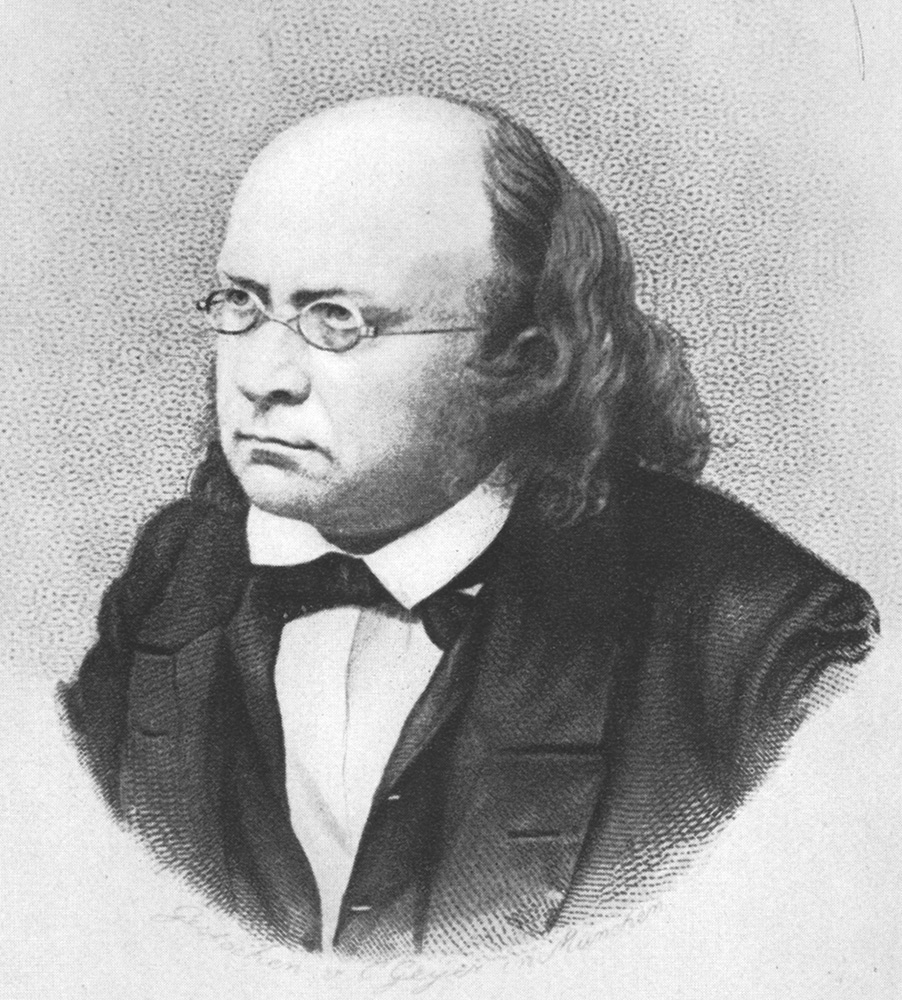
Portrait of Karl Friedrich Schimper, engraving by C. Geyer, 1866
His observations regarding the hop boom in his hometown of Schwetzingen deeply moved his sensitive soul, all the more so because the starting point for this was a natural product – namely, hops. Records from him dating from the period between 1860 and 1863 are preserved in our museum archives, providing a rare and vivid picture of hops from that time.
A hundredweight of hops currently fetched 150 guilders, Schimper noted in the fall of 1860. At that time, the annual income of a farming family would thus have been covered by the sale of two to three hundredweights of hops. The mood was correspondingly excited everywhere – on the streets of Schwetzingen, in the taverns of Schwetzingen. The streets were teeming with hop merchants; there was a “hazardous atmosphere,” as the poetically gifted naturalist called it, adding with a touch of exaggeration:
“In every tavern, one sees payments being made so that the tables bend and sway under the weight of the rolls of money.”
But Schimper did not merely note the spectacle surrounding the hop sales. He also reported, for example, on the drying process for hops that was customary at the time:
“As I was just looking out the window at the clock, Mr. Trautmann went home downstairs (…) and a large number of small kilns were being transported alongside him (…) with which the people of Schwetzingen are now increasing their drying capacity twentyfold, and which still provide Hartung, who makes them for here (…), with plenty of work and bring in money. Once you have them, they last for many years, since any repairs are easy and can be done by anyone – but it will still take a while before everyone who benefits from this fairly new improvement in hop drying and needs them will have enough of them, and the carpenter with the steam saw will still earn a little.”
The kilns he mentions here were lightweight frames with woven-in bottoms on which the hops could dry under a roof. A precursor to the hot-air drying of hops common today. Those who did not own such frames had to dry the hops directly in the attic. Hence Schimper’s somewhat flawed comparison with the carpenter’s saw.
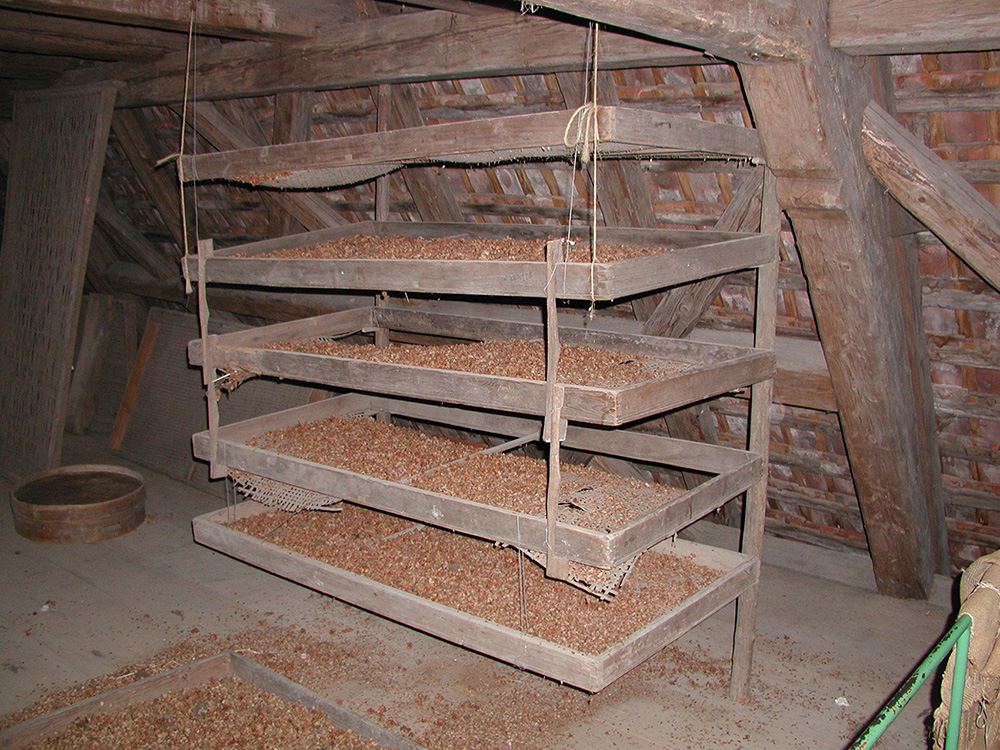
Hop drying kilns hung one above the other, Bad Windsheim Open-Air Museum, 2004
The hop harvest, as was customary at the time, did not yet take place in the hop garden, but at home:
“I went out (…) and saw the familiar sight, right in the neighborhood (…), of a large group sitting together in the draft of an open gate to the left, and, half-hidden by it, ‘picking hops’.”
Schimper knew from the innkeeper of the Adler inn in Schwetzingen that, although he had been spared from aphids in June, he was now, shortly before the harvest, struggling with something he called “Köpfchenbrand.” This was a term commonly used at the time for an infestation of “red spider mites,”. At the same time, a clear indication that pest infestations in hop cultivation were by no means a 20th-century invention.
Naturalist Schimper had yet another scourge to report:
“The wind has caused immense damage; it has knocked down countless hop poles—of 500, on average, usually only 20 remained! So the people (…) had to set the poles upright on Sunday. The Reverend and Dean Junker had the Christian grace to permit such a thing on the occasion of Sunday church!”
Kind of the Reverend, and at the same time proof that fallen hop poles were easier to set upright back then than collapsed wire trellises in later times.

Dissertation by Ludwig Chelius: Hop Cultivation in Schwetzingen, 1914.
Despite pests, storms, and difficulties in supplying the hops: nothing could dampen the euphoric mood caused by the hop abundance among the people of Schwetzingen:
“Here, people are generally busy with hops, and especially in the early morning, it’s bustling with carts rushing in, loaded with the fresh harvest, into the hop-drunk town. I have never seen more hops on the poles than this year, specifically in Neurott, which stretches to the left of Grenzhöfer Weg toward the Eichwäldchen (…) – what I saw there about 10 days ago was unprecedented – so tall, so full, so overloaded, impenetrable clusters,”
By which Schimper meant the densely overgrown hop poles. Carried away by the euphoria himself, the romantically inclined naturalist’s emotions overflowed:
“It has probably been a long time since the harvest began so early,”
and
“during the feast (…) the first glimpse of sunshine fell upon the hop growers, and the best of spirits arose among my neighbors at the table at the Erbprinzen – now the harvest could be completed!”
Just a few years later, in 1863, however, the far-sighted scholar observed a phenomenon that would continue to shape the history of hops to this day: a good harvest was by no means a guarantee of a good income:
“There is an abundance of hops this year (…) With this quite unusual bounty, the people of Schwetzingen will not earn more from the full harvest – as I quietly foresee (it’s not worth saying aloud, for one would be killed) – than in some average years that yielded not half as much – for the hops have turned out just as extraordinarily well in Franconia and Bohemia. So one simply needs more hands for less money.”
In their ‘hop-induced euphoria,’ the people of Schwetzingen thus wanted to hear nothing of the economic mechanisms of supply and demand. In the long run, however, it was all to no avail. Just a few decades later, they were mercilessly overwhelmed by developments in the hop market. As early as 1899, the Schwetzingen hop seal, as it was called, was “used for the last time.”
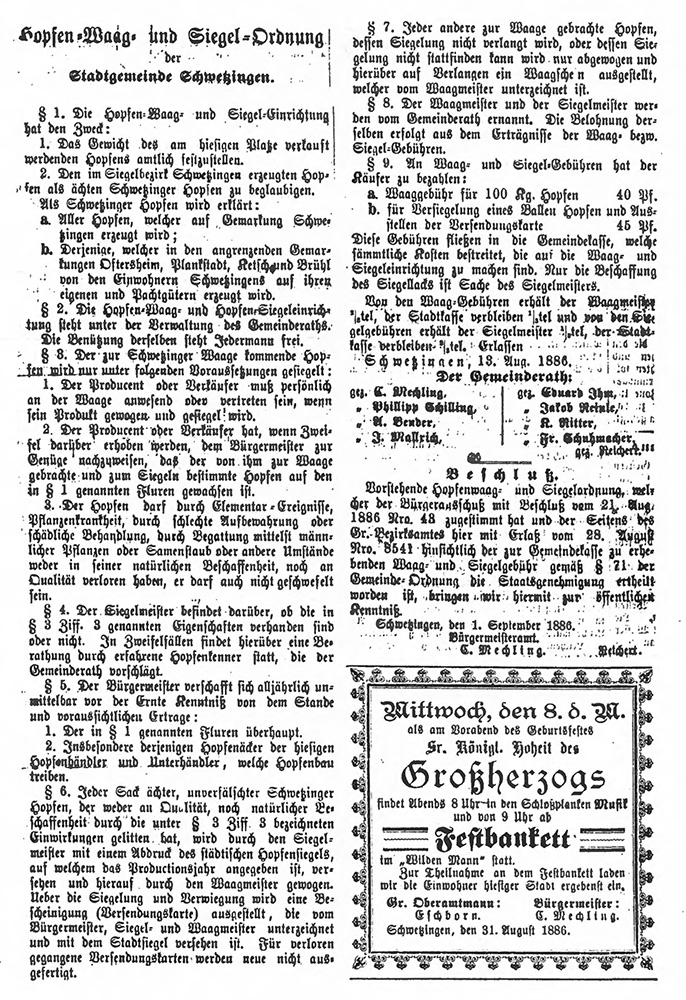
Hop Weighing and Sealing Regulations of the Municipality of Schwetzingen, 1886.
Karl Friedrich Schimper did not live to see the decline of hops in his hometown of Schwetzingen. He died as early as 1867. Today, nothing in the city reminds us of the former “hop-induced euphoria.”