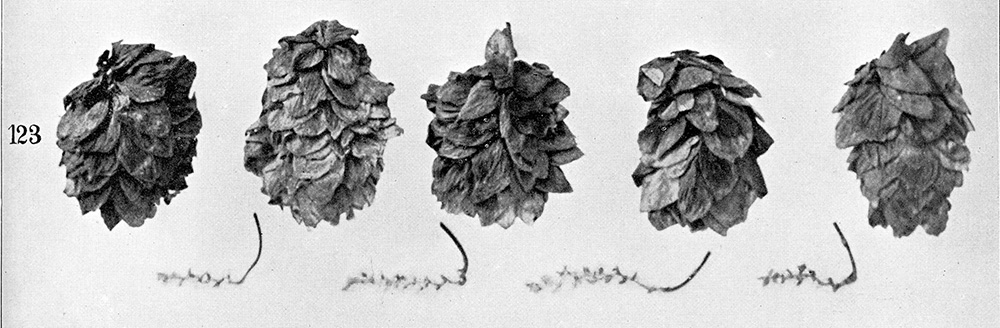
Hirschberger, Hierländer, and Prackenfelser Spät
The Bavarian Hop-Growing Consultant and the Old Hop Varieties
Hirschberger, Hierländer, and Prackenfelser Spät
The Bavarian Hop-Growing Consultant and the Old Hop Varieties
By Christoph Pinzl
After decades of prosperity, hop-growing fell into a severe crisis beginning in 1890. In Bavaria, the land of beer, this specialty crop had by then become of vital importance to the state. That’s why the state government didn’t hesitate. In 1899, it appointed Friedrich Wagner, a professor of agriculture at Weihenstephan, as the “Consultant for Hop Growing in the Kingdom of Bavaria” – a sort of “hop minister.” He was tasked with taking care of everything to ensure that Bavarian breweries never ran out of hops and that their world-famous beer didn’t suffer as a result.
And Wagner took care of it. Pretty much everything that could get hop cultivation back on track. His most important credo was: Quality, quality, quality. Anyone who wanted to persuade the brewing industry to pay better prices for hops again had to deliver the best, the very best quality. In addition to techniques that were new at the time, such as hot-air drying and wire racks, variety management was central to Wagner’s approach. Around his Weihenstephan Institute, he established what were known as “varietal gardens”, hop gardens where many different hop varieties grew, giving Wagner the opportunity to study their distinct characteristics in practice.
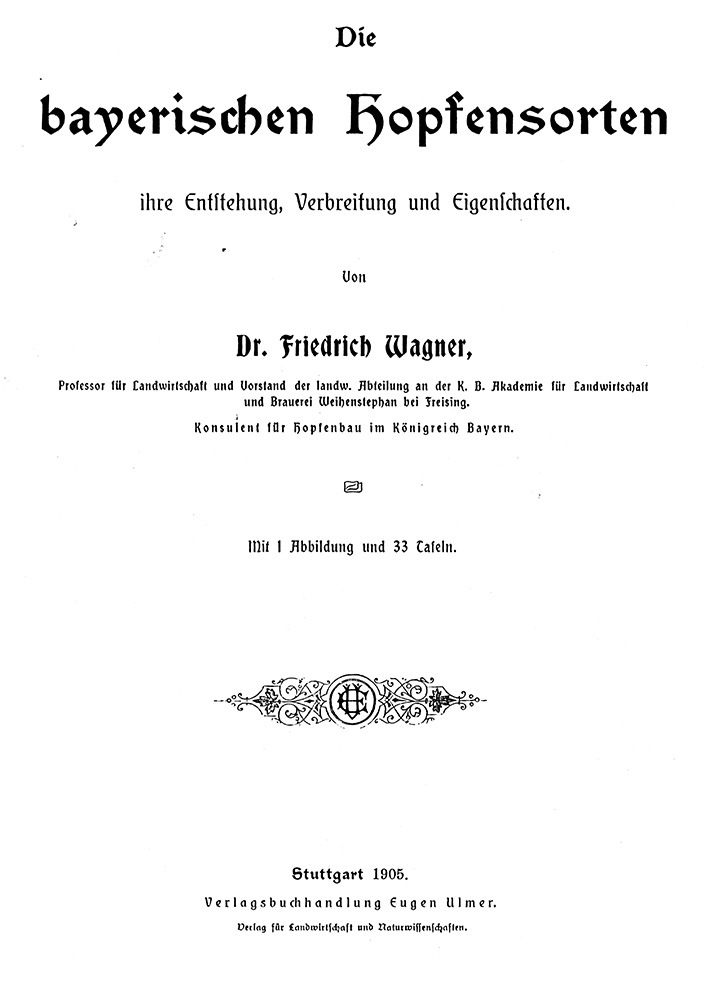
Title page of Friedrich Wagner’s book on Bavarian hop varieties.
As early as 1905, he published a comprehensive study titled “The Bavarian Hop Varieties, Their Origin, Distribution, and Characteristics.” For us today, this is one of the most important sources on which hops used to grow in Bavarian hop gardens. The names listed there now form a smorgasbord of long-forgotten and extinct hop varieties. But Wagner didn’t just provide the old names; he also described each variety, its growth, characteristics, advantages, and disadvantages and sometimes even its origin, who had introduced it where, and why. He was particularly interested in what happened when a variety was moved from one region to another. To find all this out, he had sent out questionnaires in advance to several hundred hop growers throughout Bavaria. They were peppered with questions such as
“How long has this hop variety been grown in your area?”
“On what type of soil does the variety thrive best?
“Is the variety popular in the market, and why?”
“Is the variety susceptible to fungal diseases and pests?
all the way to
“What conditions promote cone cone formation?”
“Does the hop powder discolor quickly if the hops remain on the pole too long?”
“Are the cones well-closed, and what aroma do they have?”
“Is training two or three vines more practical, and why?”
A total of 46 questions, the answers to each of which would have amounted to a small doctoral thesis on the variety. It’s not entirely surprising that “the answers to the questions were not provided with the critical rigor that would have been desirable,” as the professor noted somewhat disillusioned. Perhaps the professor also misjudged the willingness of his grower clients to simply pass on their own experiences—if such precise experiences even existed in the first place. In any case, Wagner was ultimately satisfied, “after all, a great many valuable contributions to the characterization of Bavarian hop varieties did emerge.”
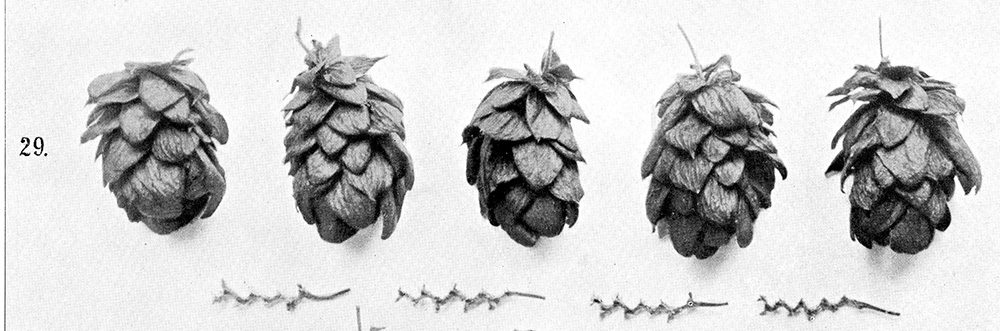
Prackenfelser Spät, from the Hersbruck growing region
First, he classified the shapes of the bracts into categories such as “rounded-inverted ovate, narrowing toward the base (Spalter bract shape)” or “narrow-elliptical, not narrowing enough toward the base (Hallertauer bract shape).” This was an attempt to gain some understanding of the individual varieties based on their appearance. He did not consult the description of the vines’ growth habit which is just as important today, presumably due to a lack of visual reference material.
Wagner then described the situation in the individual growing regions. In the Spalter region, for example, 80% of the hops grown were “genuine mid-early Spalter hops.” However one might interpret “genuine” today. Decades later, it was discovered that this Spalter hop bears a strong genetic resemblance to the variety from Saaz in Bohemia. But Wagner could not have known that at the time, and so that is another story. In Hersbruck, Hersbrucker Spät was the predominant variety, and in the Hallertau, Hallertauer Mittelfrüh.
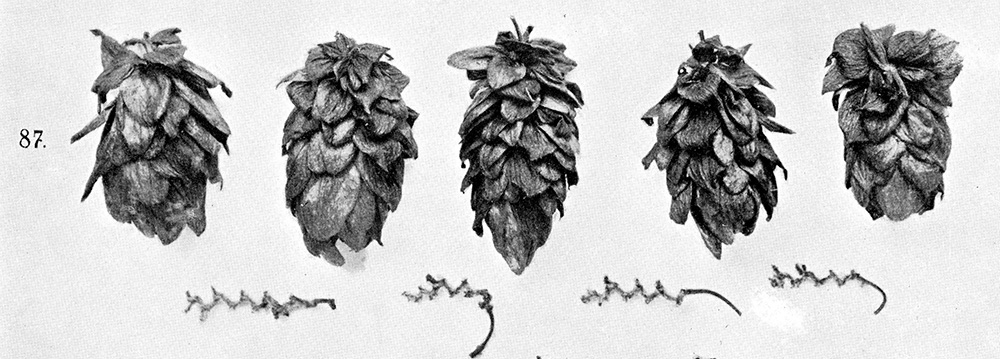
Kindinger Spät
But there are also such illustrious names as Altensittenbacher Frühhopfen, Sperber hops, and Gaisreuther Spät, all long forgotten today. We learn that grower Hiemer from Großweingarten in the Spalt region had been cultivating Hallertauer Mittelfrüh for 20 years, that Xaver Steinberger from Siegenburg in the Hallertau had also been growing Schwetzinger, that is hops from Baden, for two years, and that his colleague Schrag in Pfaffenhofen had been experimenting with Mittelfrüh Gelbspalter for some time. We hear about Hub hops, also known as Rückersdorfer Frühhopfen, which were widespread in the Hersbruck Mountains, as well as the Prackenfelser Spät, which thrived there particularly well on rich, loamy soils. Both were new varieties rather than old stock.
In the Aischgrund region, the “Aischgründer Spät” still dominated, but new varieties such as the Mittelfrühe Aischgründer were gaining ground. In the Kinding area which later became part of the Jura region and is now included in the Spalt growing region, the Kinding Späthopfen accounted for 50% of the crop. But Hallertauer Mittelfrüh is becoming just as widespread there as it is in the Aischgrund. A variety called “Hirschberger Spät”, which was actually a “Hersbrucker Spät”, was also increasingly found in the hop gardens.
Traces of varieties that were once native to the region could still be found as well. In the Hallertau in particular, alongside the now-famous “Hallertauer Mittelfrüh,” another variety was native to the region: an old early-harvest hop generally referred to as “Hierländer.” It “was, in any case, already widely cultivated in the Hallertau, particularly in Upper Bavaria, from the earliest times.” Wagner even speculates that in the past, only Hierländer was grown there. Thus, the “old local variety” in the Hallertau would actually be a different one than is assumed today. The name “Hierländer” (from this country) somehow conveys this as well. Incidentally, Hallertau growers also liked to call the Hallertauer Mittelfrüh “Grünspalter.” But not so much because it originally came from Spalt: “The word ‘Spalter’ was initially meant only to indicate a higher quality of hops.” In plain language: Hallertau hop farmers used the hops of their Spalt competitors as a marketing term. No one would dare do that today.
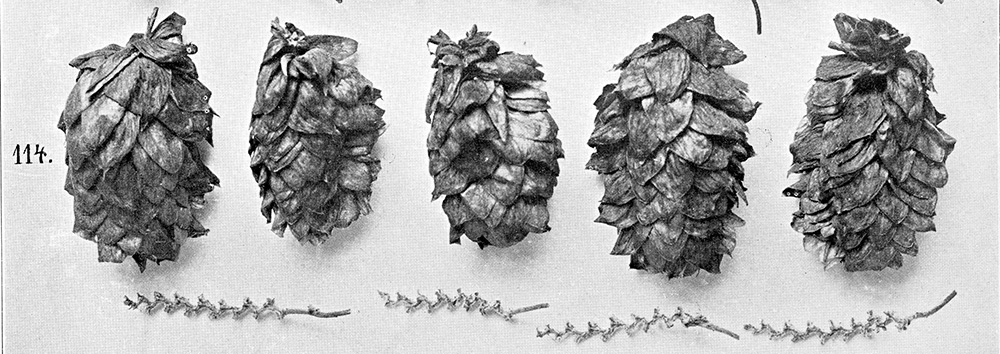
Hierländer, the old hop variety of the Hallertau
Wagner also noted that introduced varieties behaved differently in their new locations. Some exhibited the same characteristics as at their original site despite changes in climate and soil (Hallertauer grown in Spalt), while others adopted the distinctive traits of the local hops in terms of both aroma and shape (Tettnanger grown in Spalt).
Friedrich Wagner’s observations took place at a time when the “old local varieties” were already widespread. But the dominance of these varieties in the regions was by no means as clear-cut as one might think today. New varieties were on the rise, older ones were disappearing, and all varieties were now being actively exchanged back and forth between regions. The changes of the 1950s then brought about the final shift to cultivated varieties, largely derived from hop research. The era of regional varieties was finally drawing to a close.